The art of the home
Low 2.40 m ceiling: which ceiling fan to choose without sacrificing floor clearance?
Published on ·5 min read
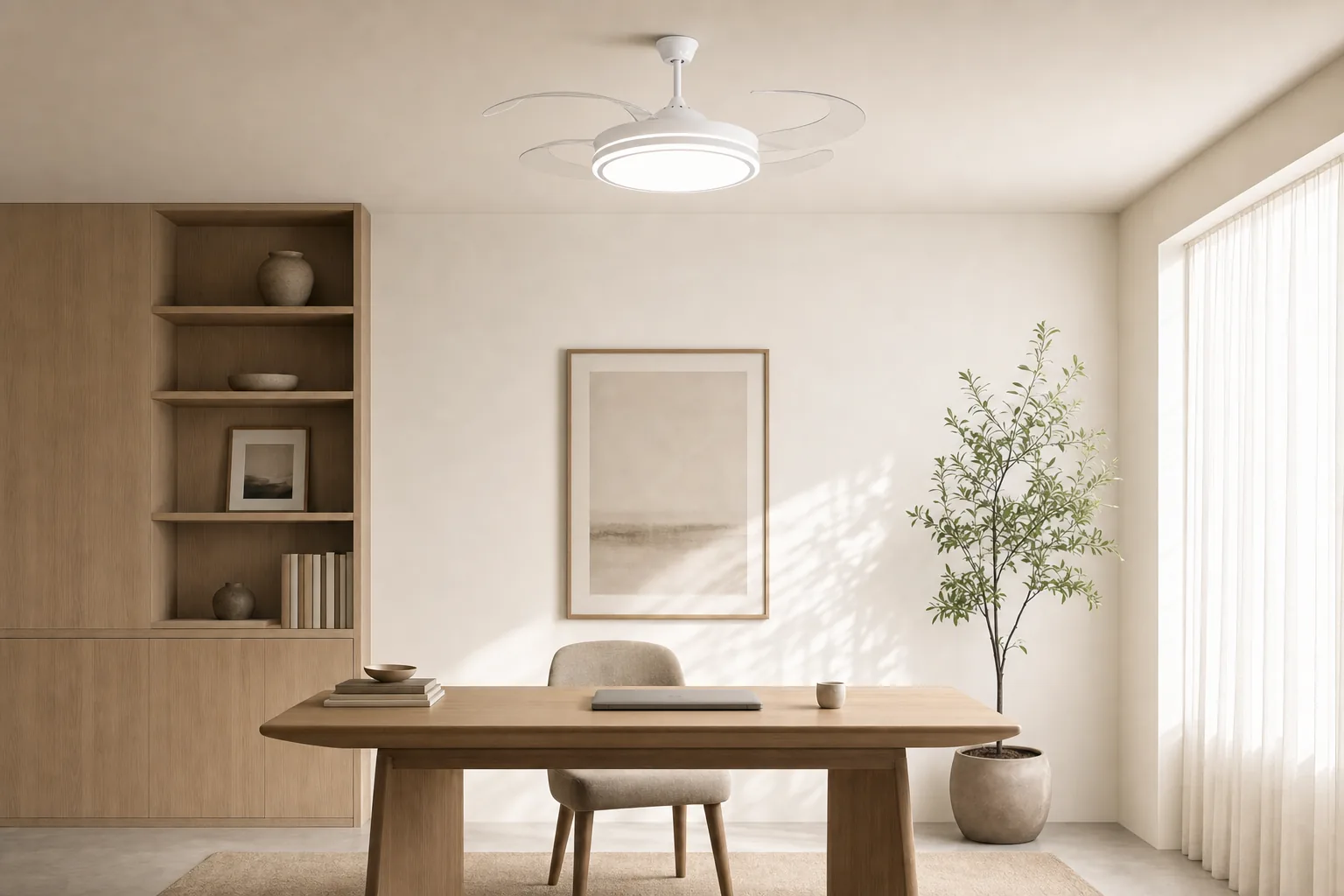
2.40 m is the ceiling height of millions of modern apartments: comfortable to live under, supposedly too tight for a ceiling fan. That is wrong, on one strict condition: keep the 2.10 m floor clearance under the blades, which means choosing a fan that fits within the remaining 30 cm.
This guide covers the height rule, the compact profiles designed for this constraint, the small-diameter strategy for compact rooms, and the mistakes that turn a good purchase into a daily annoyance.
The 2.10 m rule under the blades: where it comes from
The 2.10 m floor clearance is the safety rule commonly adopted by European manufacturers and installers: below it, spinning blades reach the height of a raised adult arm. Under a 2.40 m ceiling the arithmetic is simple: 2.40 minus 2.10 leaves 30 cm of total thickness for mounting, motor body and blades.
That figure rules out every downrod model, designed for ceilings of 2.70 m and above, and narrows the choice to two families: flush-mounted profiles and compact small diameters. The good news: the constraint costs almost nothing in performance, wind-chill needs slow, steady rotation, not height.
Flush profiles and small formats: the two compatible families
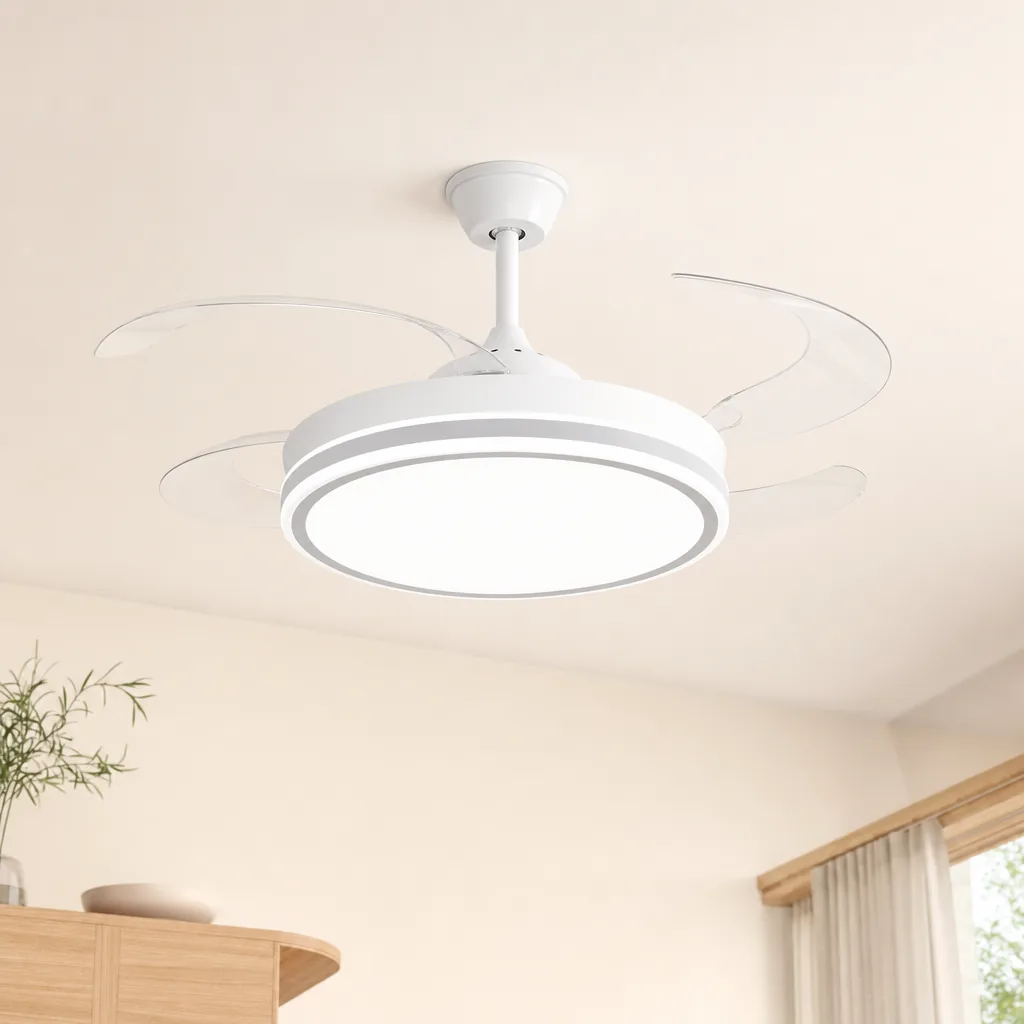
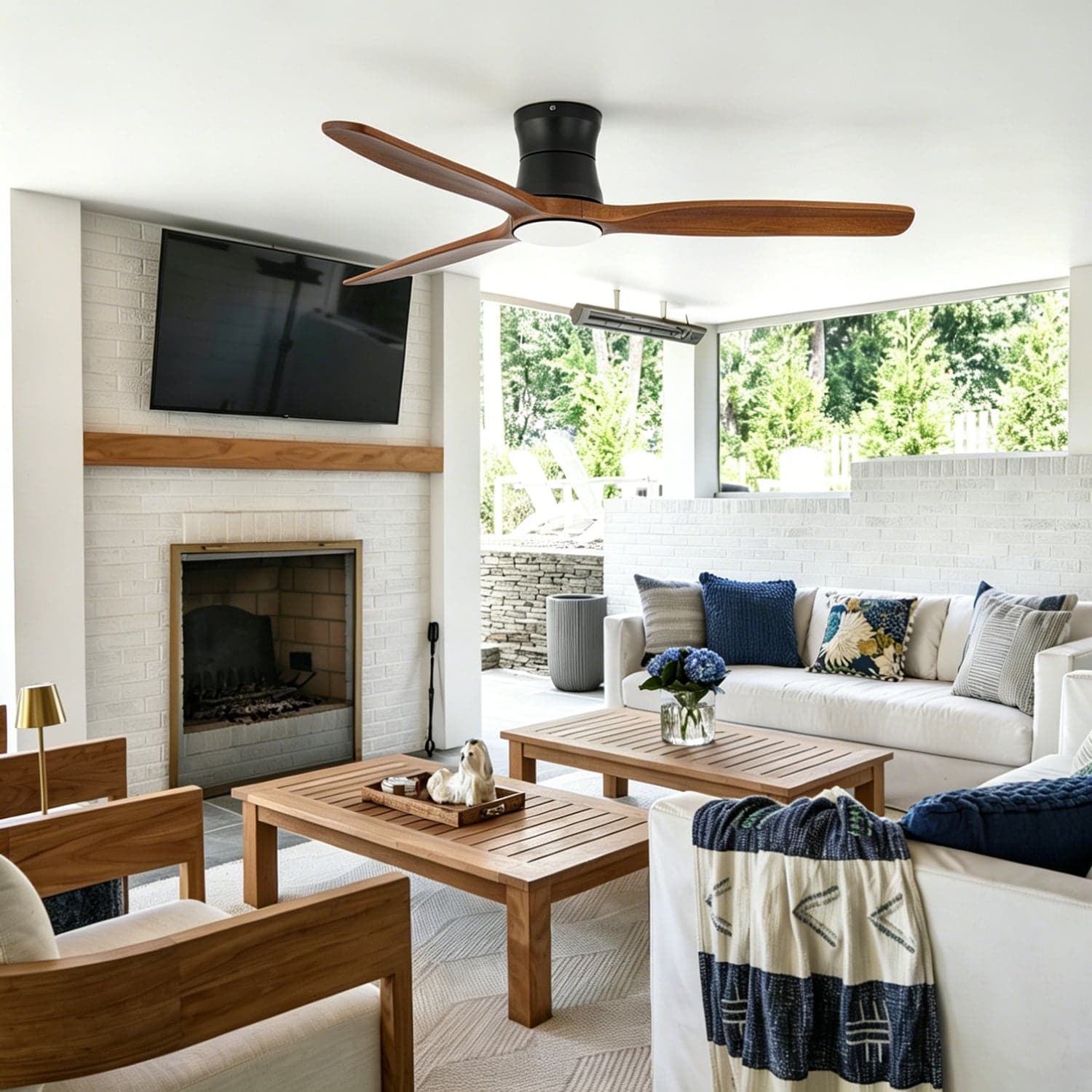
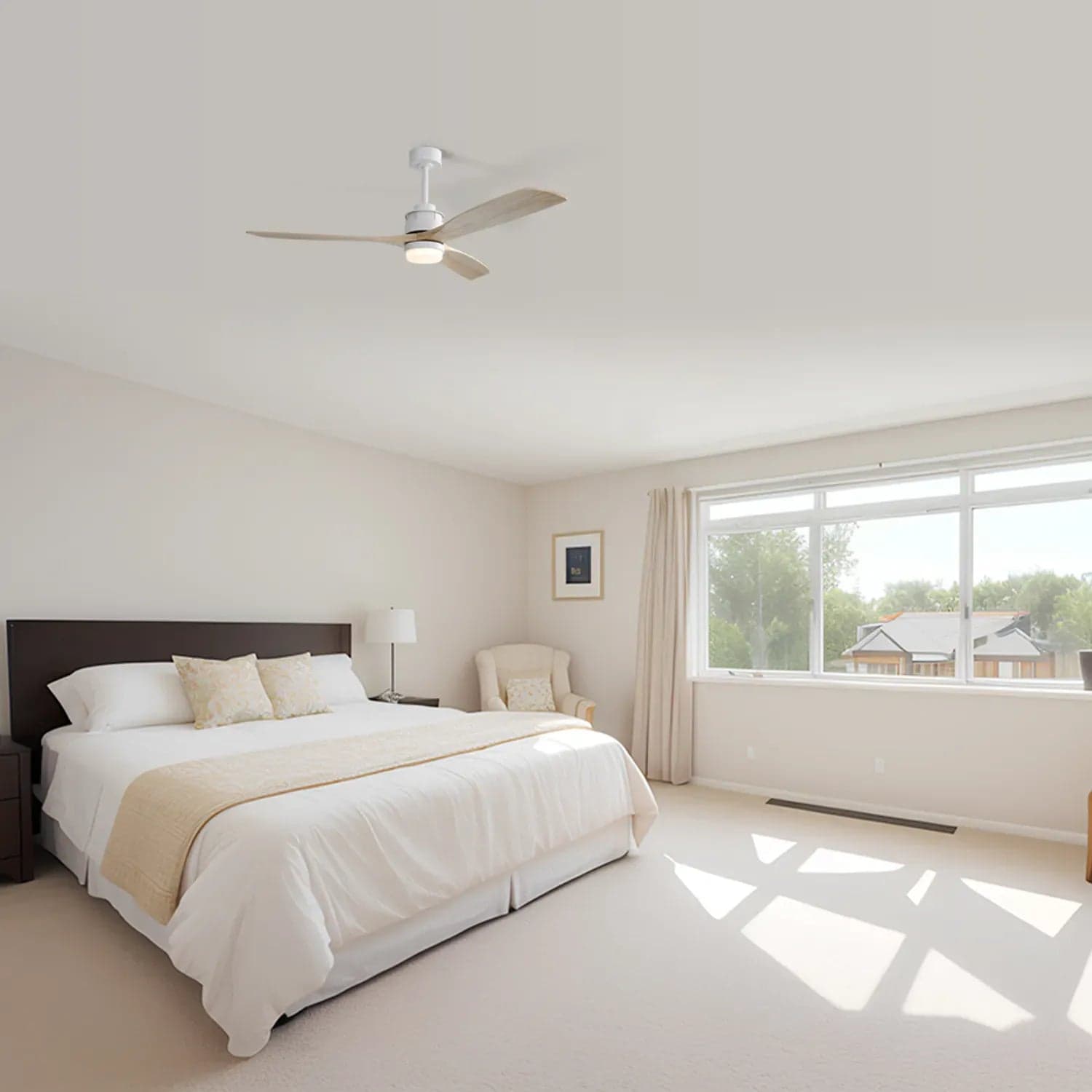
Flush or hugger profiles mount the motor body directly to the ceiling, no downrod, with a total drop of only 25 to 35 cm. They exist up to large diameters, making them the solution for low-ceiling living rooms.
The second family is compact small diameters, 51 to 91 cm, for rooms with modest surfaces. That is the territory of a model like the Atelier 51: a 51 cm span, a matte black steel cage with industrial spirit and an exposed filament bulb, cut out for offices, hallways, kitchens and utility rooms. Above 15 m², choose a large flush profile; below, the compact format preserves the room's proportions.
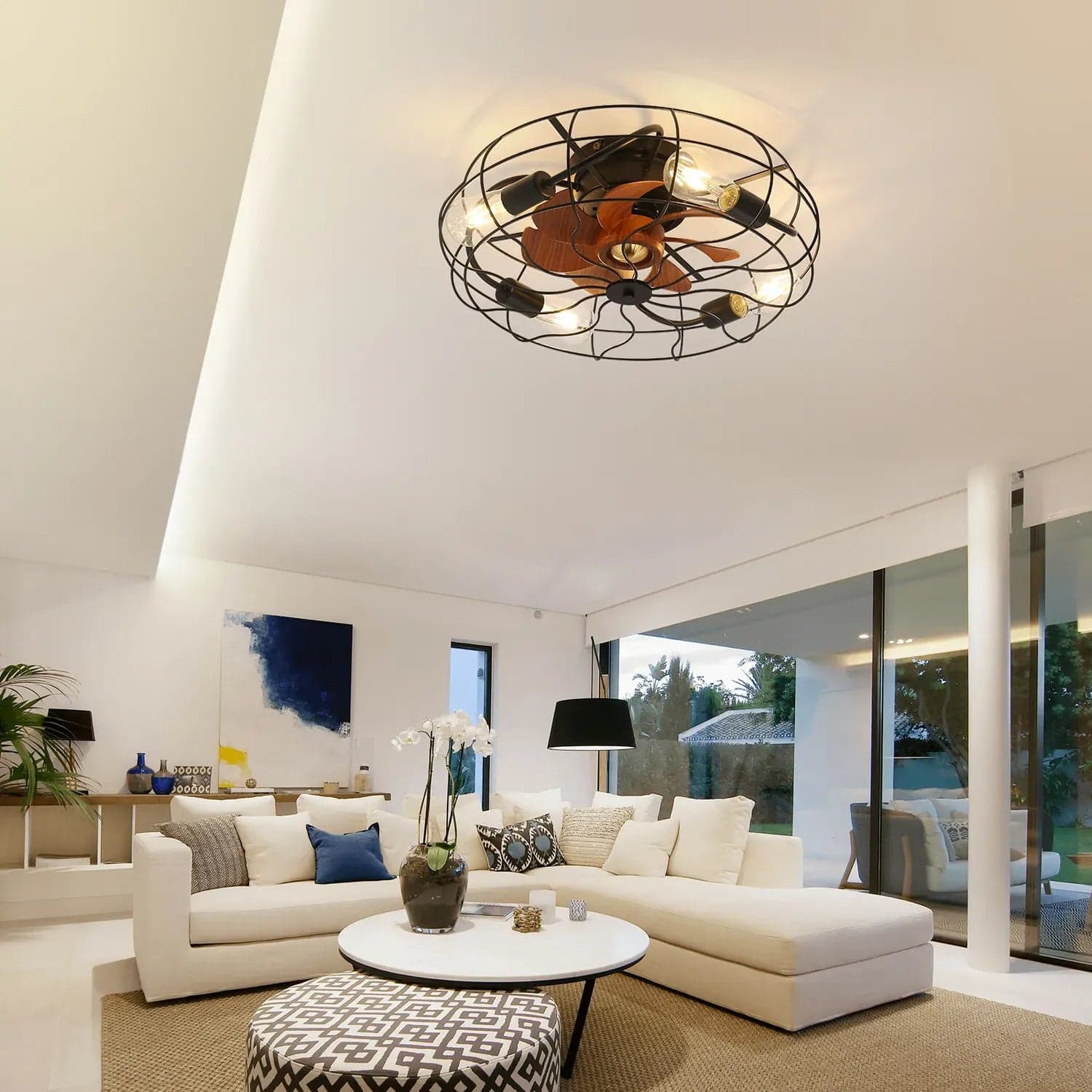
The Atelier 51
Industrial spirit · Ø 51 cm · Cage & light
- ✓Assertive industrial style: matte black steel cage
- ✓Compact 51 cm format, hallways, kitchens, utility rooms
- ✓Exposed-bulb lighting (E27, LED compatible)
US$199
Compact low-ceiling rooms: the small-diameter strategy
An 8 m² office, a hallway, a closed kitchen: these rooms combine low ceilings and small surfaces, exactly where the small diameter shines. In an office, a desk fan clutters the worktop and blows papers around; a small ceiling-mounted format stirs the air overhead with no directed draft, and frees the desk. The Atelier 51 adds light: its E27 socket, filament-LED compatible, makes it the room's pendant too, two functions on a single electrical point.
One honest caveat: compact formats often offer 3 speeds rather than 6, and a slightly higher maximum noise level than large slow motors, up to 38 dB at full speed. Discreet in a work or transit room; for a bedroom, prefer a model dedicated to sleep.
The classic mistakes under a low ceiling
The most frequent mistake is installing a downrod model 'with a shortened rod': even reduced, the rod adds decisive centimetres and, poorly matched, encourages wobble. A fan designed for flush mounting is balanced for that position; an improvised one is not.
The second mistake is forgetting what lives under the fan: a tall wardrobe door, a mezzanine, a floor lamp. At 2.40 m, every tall element in the room must be checked before fixing the location.
- ·Never less than 2.10 m between floor and blades, no exceptions
- ·No downrod under a 2.50 m ceiling: flush mounting required
- ·Check tall cupboard doors and furniture under the rotation zone
- ·Keep 50 cm between blade tips and walls for turbulence-free flow
- ·Under 15 m², prefer a small diameter: sufficient coverage, preserved proportions
Real comfort under 2.40 m: what a low ceiling changes, and what it does not
A low ceiling even has an overlooked advantage: less air volume to move, so the fan reaches cruising speed at a lower setting. In summer the cool sensation settles in minutes; in winter a reversible model brings down the warm air that stratifies at the ceiling even at 2.40 m.
What does not change: the fundamentals. A remote control instead of a dangling pull chain, a clear manual for a half-hour installation, and a 2-year warranty. A low ceiling restricts formats, not standards.
A 2.40 m ceiling does not forbid a ceiling fan, it imposes discipline: 2.10 m under the blades, hence 30 cm maximum for the fan, flush profile in large rooms, small diameter in compact ones. For a low-ceiling office, hallway or kitchen, the Atelier 51 is the obvious choice: a 51 cm span, a matte black steel cage with assertive industrial style, exposed-bulb lighting, 3 remote-controlled speeds and a 2-year warranty. Proof that a low ceiling can host character without ever cutting into floor clearance.
Frequently asked questions
Can you install a ceiling fan under a 2.40 m ceiling?+
Yes, with a compact model mounted directly to the ceiling, without a downrod. The complete fan must fit within 30 cm to keep the 2.10 m safety clearance between floor and blades. Flush profiles and small diameters are designed for exactly this.
What is the minimum height under ceiling fan blades?+
2.10 m between floor and blades, the safety rule commonly adopted by European manufacturers. Below that, spinning blades reach raised-arm height. Check before buying: ceiling height minus the fan's total height.
Is a small 51 cm fan really effective?+
Yes, in the rooms it is made for: offices, hallways, kitchens and utility rooms up to about 10 m². On those surfaces it creates the same 3 to 4°C perceived cooling as a large model in a living room. Efficiency comes from matching diameter to surface, not from absolute size.
The SEY Maison Circle
Every month, an exceptional piece. Never reissued.
The Drops principle: one high-end furniture piece per month, in a numbered edition. Once it's gone, it never comes back. Circle members are notified 48 h early, access each drop 24 h before everyone else, and receive our guides before publication.
Discover the Drops →