The art of the home
Ceiling fan for the living room: the complete buying guide
Published on ·8 min read
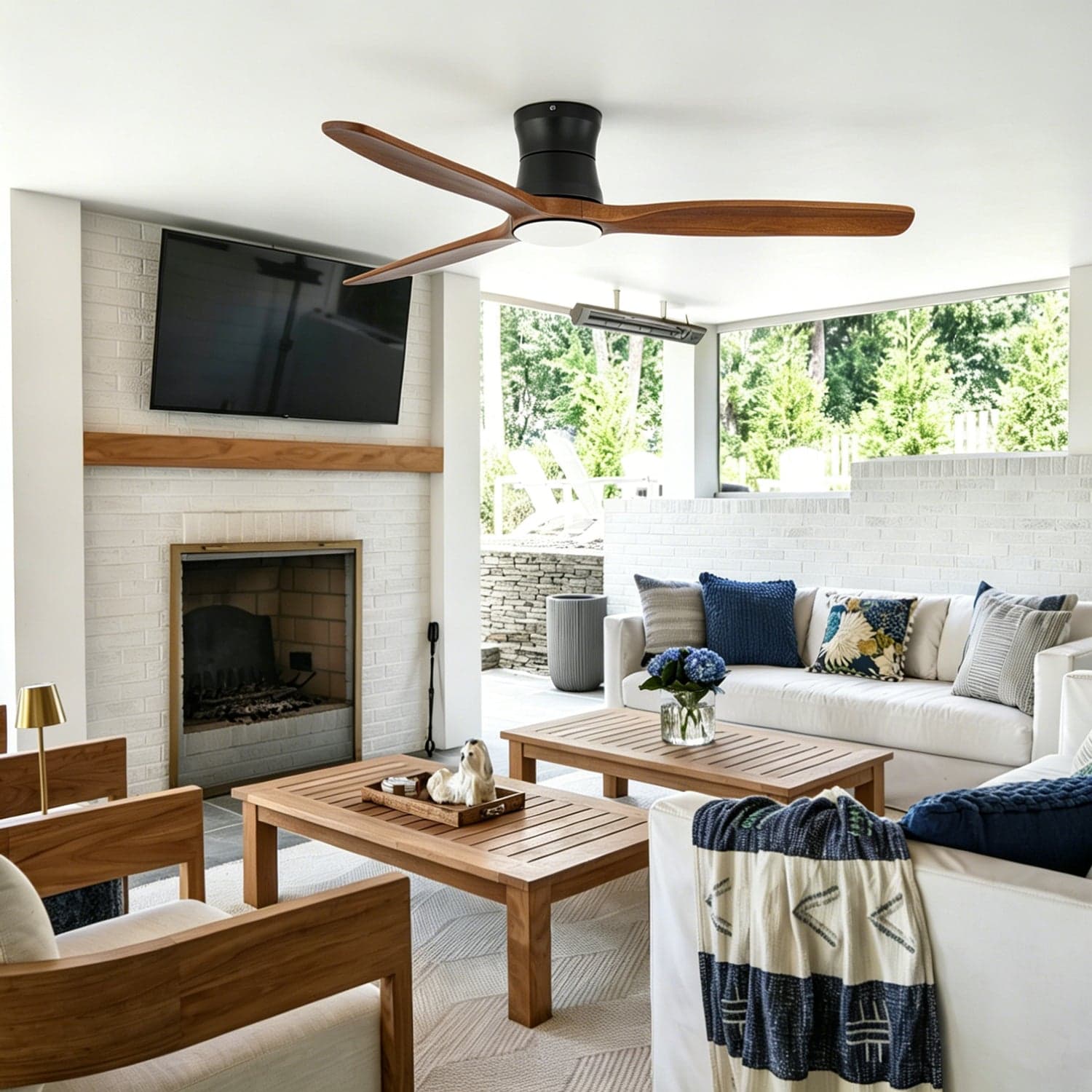
In a bedroom, a ceiling fan is chosen with the ears. In a living room, it is also chosen with the eyes. This is the room where you entertain, where evenings are spent, where every object hanging from the ceiling is seen, compared, and judged. A living room fan is therefore a double wager: it must cool what is often a generous floor area, and it must do so as a confident design object, worthy of the sofa, the lighting, and the joinery around it.
This guide walks through the criteria that genuinely matter for a living room ceiling fan: the diameter matched to the floor area, the placement above the living zone, the stylistic harmony with the rest of the room, the silence a conversation room demands, the integrated light, winter reverse mode, and the most common mistakes, starting with the undersized diameter.
Diameter first: the floor-area rule for living rooms
The first criterion for a living room ceiling fan is neither style nor price: it is diameter, dictated by floor area. Living rooms rarely fall below 20 m², and from 25 m² upwards, a minimum diameter of 132 cm is essential. Anything smaller has to spin fast to cover the room, producing a quick, localised draught, the exact opposite of the comfort you want in a room where people sit for hours.
For open-plan living spaces connected to the kitchen or dining area, up to 35 m², the right range is 132 to 152 cm, positioned above the centre of the living zone. A large diameter moves a substantial volume of air at low speed: the circulation is wide, gentle, and even, and the perceived cooling reaches 3 to 4 °C without ever feeling like a draught. That is the logic behind SEY Maison's large formats, from the Fjord 132 to the Grand Air 152 with its 152 cm span.
- ·Living room up to 25 m²: minimum 132 cm diameter
- ·Open-plan living space up to 35 m²: 132 to 152 cm, above the centre of the living zone
- ·Golden rule: for a given floor area, always favour the largest diameter the room can take
Placement: the centre of the living zone, not the room
The classic mistake is installing the fan at the geometric centre of the living room. What actually matters is the centre of the living zone: the space where people genuinely sit, between the sofa, the armchairs, and the coffee table. In an L-shaped room or a large open space, the geometric centre may fall above a walkway where nobody benefits from the airflow. Position the fan above the seating area, even if that means offsetting it relative to the walls.
Distances matter too. A large diameter above the sofa should turn slowly, which is precisely what the 132-152 cm formats allow: the air descends in a broad column and envelops the seating area without blowing directly onto faces. If the space includes a dining corner, two approaches work: centre the fan between the two zones in a compact space, or favour the sofa zone, where people spend the most time sitting still, and where the cooling effect is felt most clearly.
Style: an object seen every day, matched to the room
In a living room, the ceiling fan occupies the ceiling's focal point, the traditional spot of the chandelier. It will be seen every day, by you and by your guests: its design matters as much as its performance. Three broad families answer three moods. Solid wood, warm and textured, suits Scandinavian, bohemian, or classic interiors: that is the stance of the Fjord 132 with its three oiled solid wood blades, or the Héritage 132 in solid walnut, deeper and more subdued. Black, graphic, structures contemporary interiors. White, discreet, blends into the ceiling and leaves the furniture in the spotlight.
The right reflex is to match the fan to the existing light fittings and joinery rather than to the sofa alone, which gets replaced more often. Brass pendants and oak flooring call for a light wood like the Grand Air 152; black window frames and discreet spotlights welcome a graphic piece; mouldings and ornate ceilings prefer a restrained design that does not compete with the decor. A well-matched fan disappears into the coherence of the room while remaining, still or in motion, an object you enjoy looking at.
The Fjord 132
Solid wood · Ø 132 cm · Three Scandinavian blades
- ✓Oiled solid-wood blades, every unit is unique
- ✓Three-blade Scandinavian design: sculptural, never heavy
- ✓Ultra-silent DC motor, slow large-volume airflow
€419€529
Silence: the non-negotiable condition of a living space
The living room is the room of conversation, the evening film, and reading. An audible appliance is disqualified from the start: the hum of a low-end AC motor intrudes on a film's dialogue and quietly wears you down over the course of an evening. The right benchmark for a living space sits between 32 and 35 dB, the range of SEY Maison's large formats: at that level, the fan retreats behind the quietest conversation and is simply not heard during a film.
That silence is the work of DC motors. The Fjord 132 tops out at 32 dB at maximum speed thanks to its ultra-quiet DC motor: even running flat out on a heatwave afternoon, it stays below the threshold where the ear starts isolating a sound in a calm room. One point deserves attention when buying: insist on the noise level at maximum speed, not just at minimum speed, because it is at full speed, in the hottest hours, that silence is truly tested.
Integrated light and winter mode: one object, three functions
In most living rooms, the central point of the ceiling is already occupied by a ceiling light or a pendant. A fan with an integrated light resolves the equation elegantly: it replaces the central fixture instead of competing with it, with no additional drilling or new wiring. Installation takes 30 minutes on the existing light point, making it one of the rare high-impact decorating moves achievable in a single morning.
The other overlooked function is reverse mode. In winter, warm air from the heating accumulates at the ceiling, precisely where nobody benefits from it. By reversing the direction of rotation, the fan gently pushes that warm layer back down along the walls and evens out the room temperature, with no perceptible draught. The Héritage 132, with its reversible DC motor, embodies this four-season operation: cooling circulation in summer, heat redistribution in winter. The living room fan stops being seasonal equipment and becomes an object that earns its place twelve months a year.
The common mistakes that ruin a living room fan
The first mistake, by far the most frequent, is the undersized diameter. An undersized fan in a large living room has to compensate with speed: the airflow becomes fast, narrow, and unpleasant, and the promised comfort turns into a localised draught. Real comfort comes from the slow, wide circulation of a large diameter, never from the maximum speed of a small one. It is counter-intuitive at purchase, when the smaller format looks more reasonable, and glaring in daily use.
The other traps stem from the same misunderstanding: running the fan at maximum speed by default when the slow speeds of a large format are enough in most situations, ignoring the noise level at full speed, or choosing the fan as an invisible technical appliance when it occupies the most visible spot in the room. A final note for a serene purchase: favour a fan with lasting cover, the SEY Maison range carries a 2-year warranty, 14-day returns, and delivery in 6 to 10 working days, enough time to confirm the match with your room at home.
- ·Undersized diameter: fast, unpleasant airflow instead of slow, wide circulation
- ·Maximum speed all the time: unnecessary with a large format, the slow speeds are enough
- ·Placement at the geometric centre rather than the centre of the living zone
- ·Style chosen without looking at the existing light fittings and joinery
- ·Noise level checked only at minimum speed
Choosing a ceiling fan for a living room means getting three matches right: a diameter suited to the floor area, at least 132 cm from 25 m² and up to 152 cm for an open-plan space; a placement above the centre of the living zone; and a design in harmony with the room, at a 32 to 35 dB silence that respects conversations and film nights. The Fjord 132 with its oiled solid wood blades, the Héritage 132 in walnut, and the Grand Air 152 in light wood express that standard in three registers, with a perceived cooling of 3 to 4 °C in summer, a reverse mode for winter, and a 30-minute installation on the existing light point.
Frequently asked questions
What ceiling fan diameter for a 25 m² living room?+
For a living room of 25 m² or more, choose a diameter of at least 132 cm. A large diameter circulates air slowly and widely, delivering a perceived cooling of 3 to 4 °C without any unpleasant draught. For an open-plan living space of up to 35 m², the right range is 132 to 152 cm, installed above the centre of the living zone.
Where should a ceiling fan go in an open-plan living space?+
Above the centre of the living zone, meaning the space where people actually sit (sofa, armchairs, coffee table), and not necessarily at the geometric centre of the room. In a large open space, favour the sofa zone, where people sit still the longest and where the cooling effect is felt most clearly.
Is a ceiling fan quiet enough to watch a film?+
Yes, provided you choose a DC motor. SEY Maison's large formats operate between 32 and 35 dB: at that level, the fan retreats behind a quiet conversation and cannot be heard during a film. The Fjord 132 tops out at 32 dB even at maximum speed. Always check the stated noise level at full speed, not just at minimum speed.
Is a living room ceiling fan also useful in winter?+
Yes. In reverse mode, the fan inverts its direction of rotation and pushes the warm air accumulated at the ceiling back down along the walls, redistributing the heating throughout the room with no perceptible draught. A model with a reversible DC motor, such as the Héritage 132, is therefore useful twelve months a year.
The SEY Maison Circle
Every month, an exceptional piece. Never reissued.
The Drops principle: one high-end furniture piece per month, in a numbered edition. Once it's gone, it never comes back. Circle members are notified 48 h early, access each drop 24 h before everyone else, and receive our guides before publication.
Discover the Drops →