Comparisons & guides
The 10 questions to ask before buying a ceiling fan
Published on ·5 min read
A ceiling fan is a once-every-fifteen-years purchase: fixed at the centre of the room, permanently visible, wired to the main electrical point. Getting it wrong costs daily comfort, and product sheets, between inch-based diameters and missing noise figures, rarely help comparison.
Here is the complete checklist: ten questions in the order they should be asked, each with the figure that settles it. At the end, a model either ticks all ten boxes or it does not, and the decision makes itself.
Questions 1 to 3: the room decides before you do
Question 1: what surface must be covered? It sets the diameter, non-negotiably: an undersized fan only stirs the air under its blades and must spin fast, hence loud. When hesitating between two sizes, take the larger one. Question 2: what is the ceiling height? Safety requires 2.10 m between floor and blades; at 2.40 m that leaves 30 cm for the fan, flush profile required. From 2.70 m, a downrod becomes useful again.
Question 3: where will the power come from? With an existing central light point, installation is a 30-minute job; without one, budget an electrician to run a line.
- ·Under 10 m²: 76 to 91 cm diameter
- ·10 to 15 m²: 91 to 107 cm
- ·15 to 25 m²: 107 to 132 cm
- ·25 to 35 m²: 132 to 152 cm
- ·Clearance: 2.10 m minimum under blades, 50 cm from walls
Questions 4 to 6: noise and motor, the heart of the purchase
Question 4: is the noise level stated in figures? It is the sincerity test of a product sheet. A manufacturer confident in its motor publishes decibels: 28 to 34 dB for a quality DC motor, below a whisper. A sheet that just says 'silent' usually hides an AC motor whose hum reveals itself at night.
Question 5: AC or DC motor? DC consumes little, starts smoothly, offers fine speed control, typically 6 remote-controlled levels, and runs in a silence AC technology cannot match. Question 6: is it reversible? A winter mode reverses rotation to bring ceiling-stratified warm air back down along the walls, turning a summer appliance into a four-season one.
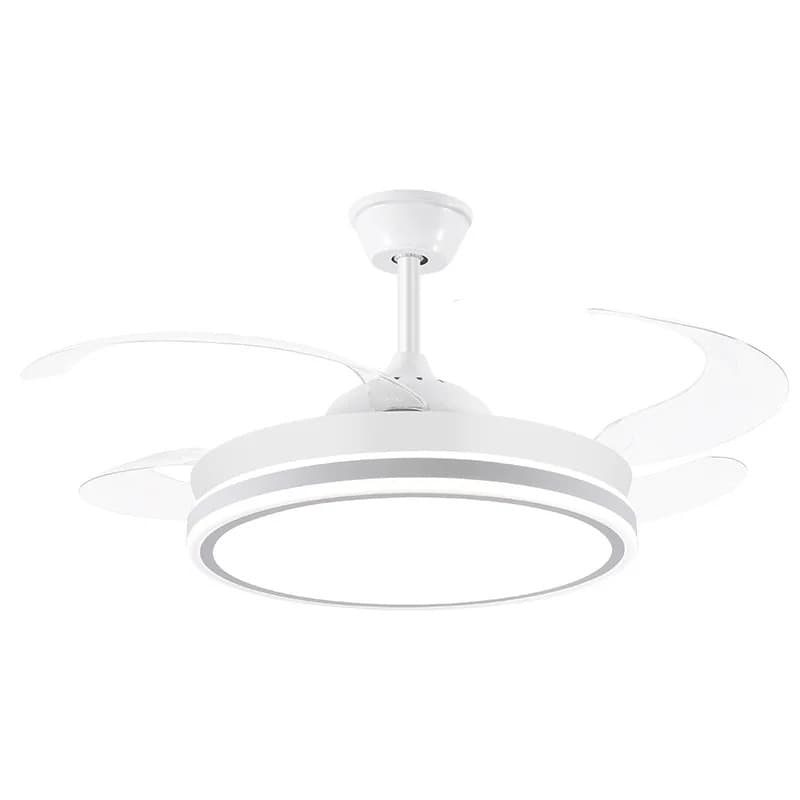
The Boréal 107
Retractable blades · Ø 107 cm · LED ceiling light & silent fan
- ✓Retractable blades: invisible when off, nobody guesses it's a fan
- ✓Sleep with windows closed, 30 dB, quieter than a whisper
- ✓Integrated LED 2700K → 6000K, dimmable: replaces your ceiling light
Questions 7 and 8: light and everyday control
Question 7: must the fan also light the room? In most rooms it replaces the central ceiling light, so a dimmable integrated LED settles the matter, with colour temperature adjustment from warm to daylight white. If the room already has considered peripheral lighting, a no-light model keeps a purer line.
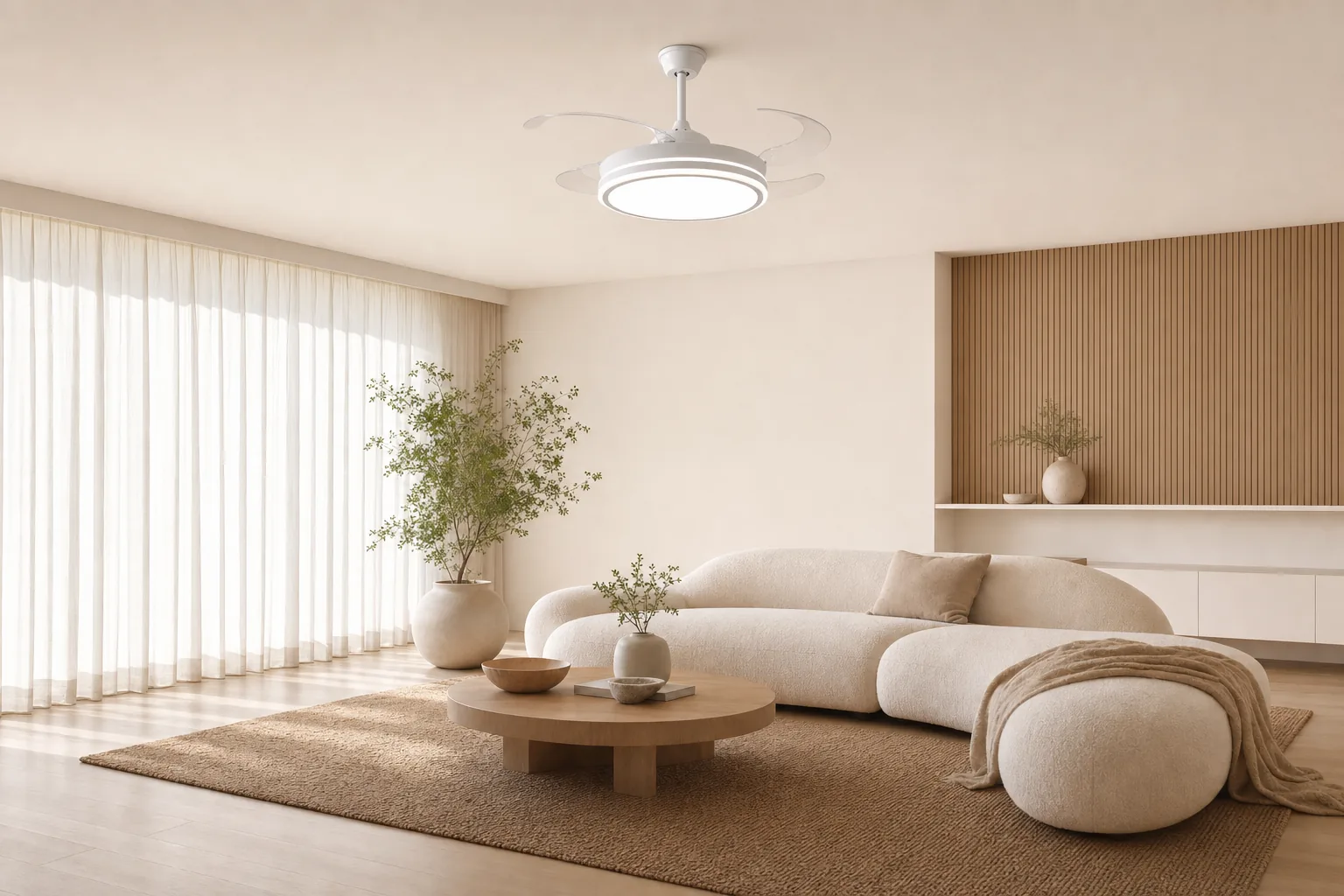
Question 8: how is it controlled? A remote is the comfort standard: speeds, light and timer from the sofa or bed, no dangling chain. This is where a model like the Boréal 107 concentrates its answer: a dimmable LED in three colour temperatures, 6 remote-controlled speeds, and retractable blades that make it read as a plain ceiling light once closed, a 107 cm span in operation, a ceiling-light silhouette at rest.
Questions 9 and 10: installation and warranty, the blind spots
Question 9: can you install it yourself? A good model mounts in 30 minutes with a clear manual on an existing light point: breaker off, bracket up, two wires, clip the body. Question 10: who answers after the purchase? A ceiling fan runs thousands of hours a year: a 2-year warranty with reachable European support is the difference between a spare part shipped in three days and a fan bound for the skip. Check delivery terms too, free above 150 € with serious brands.
- ·1. Room surface → sets the diameter
- ·2. Ceiling height → 2.10 m under blades, flush profile below 2.50 m
- ·3. Power point → existing or to be created
- ·4. Stated noise level → 28-34 dB in operation
- ·5. DC motor → silence, efficiency, fine speeds
- ·6. Reversible winter mode → useful twelve months a year
- ·7. Integrated dimmable LED → replaces the ceiling light
- ·8. Remote control → speeds and light without getting up
- ·9. Clear manual, 30-minute installation
- ·10. 2-year warranty and EU support
How to use the checklist: the three-pass method
First pass, eliminatory: questions 1, 2 and 4. A wrong diameter, impossible clearance or missing noise figure disqualify a model whatever its other qualities. This pass usually removes two thirds of candidates.
Second pass, technical: DC motor, reversible mode, light and control, questions 5 to 8, where the next decade of comfort is decided. Third pass, trust: manual, warranty, support. A model that clears all three passes without concession is a purchase you will not regret; the 3 to 4°C of perceived cooling does the rest, every summer.
Ten questions, three passes, and a decision that almost makes itself. If you want a model that runs the checklist without a snag, the Boréal 107 is the demonstration: 107 cm for rooms of 10 to 20 m², 30 to 34 dB, a dimmable three-temperature LED, 6 remote-controlled speeds, a 2-year warranty with EU support, and the unique signature of retractable blades that turn it into a discreet ceiling light the moment it stops. The checklist is made for comparing; it also helps you recognise, when you meet it, the model that ticks everything.
Frequently asked questions
What is the most important criterion before buying a ceiling fan?+
A diameter matched to the room's surface. An undersized fan must spin fast to compensate and becomes noisy whatever its motor. Set the diameter first from the surface, then separate models on noise, motor and functions.
How can you tell if a ceiling fan will be silent?+
Demand a figure: 28 to 34 dB in operation for a quality DC motor, below a whisper. A product sheet claiming 'silent' without decibels almost always signals an AC motor whose hum becomes audible at night.
Can a ceiling fan replace the existing ceiling light?+
Yes, it is the most common setup: a model with an integrated dimmable LED mounts on the central light point in 30 minutes and combines both functions. Retractable-blade models like the Boréal 107 take the logic further: closed, they look like a plain ceiling light.
The SEY Maison Circle
Every month, an exceptional piece. Never reissued.
The Drops principle: one high-end furniture piece per month, in a numbered edition. Once it's gone, it never comes back. Circle members are notified 48 h early, access each drop 24 h before everyone else, and receive our guides before publication.
Discover the Drops →