Comparisons & guides
DC or AC motor for a ceiling fan: the complete comparison
Published on ·8 min read
DC motor or AC motor: it is the first line to check on a ceiling fan's spec sheet, and probably the most decisive one. Behind those two acronyms sit two radically different motor architectures, which determine power consumption, noise level, fineness of control and, ultimately, how pleasant the fan is to live with. Yet most product pages simply display 'DC motor' as a magic word, without ever explaining what it actually changes in your home.
This comparison lays it all out, numbers included: how each technology works, what it really consumes, what it costs over a full summer, and which one to choose for each room and usage pattern. The goal is not to crown an absolute winner, but to give you a clear verdict per situation, including the cases where the good old AC motor remains a perfectly reasonable choice.
AC and DC motors: two ways of producing the same movement
The AC (alternating current) motor is the ceiling fan's historic technology. It plugs straight into mains alternating current: the magnetic field that spins the rotor is created by the natural alternation of the current itself, with no electronics in between. It is a mechanically simple design, proven over decades, with few components that can fail. Its speed is usually adjusted in coarse steps, via a capacitor or a wall regulator, and its torque at very low speed is limited.
The DC (direct current) motor inserts an electronic transformer between the mains and the motor: alternating current is converted to direct current, then finely managed by a circuit that meters exactly the energy sent to the windings. This architecture, brushless on modern models, allows precise speed control, smooth ramp-ups and ramp-downs, and rotation reversal at the press of a button. The motor only draws the energy strictly needed for the requested speed, whereas an AC motor absorbs a near-constant power.
Power consumption: the gap that changes everything
This is where the difference is most spectacular. An AC ceiling fan typically draws between 50 and 100 W depending on speed and diameter. An equivalent DC model sits between 5 and 30 W for comparable airflow, roughly 70% less energy. The reason is structural: the DC motor's electronic control adjusts power to the exact need, while an AC motor dissipates a significant share of its energy as heat in its windings.
That gap, trivial over one hour, becomes meaningful over a season. And it deserves perspective against air conditioning: a domestic split unit peaks at around 2,500 W, close to a hundred times the power of a DC fan at medium speed. Whichever motor you choose, a ceiling fan remains a frugal way to stay cool; the DC motor simply pushes that frugality to its maximum.
- ·AC motor: 50 to 100 W depending on speed and diameter
- ·DC motor: 5 to 30 W for comparable airflow
- ·Average gap: roughly 70% savings in favour of DC
- ·Air conditioning benchmark: around 2,500 W at peak for a split unit
Silence: why the DC motor is quieter at night
A ceiling fan's noise has two sources: the air moved by the blades, which cannot be eliminated, and the motor itself, vibrations and electromagnetic hum included. The DC motor takes the lead on the second one. Its electronic control delivers steady torque, without the supply pulses that make an AC motor vibrate, and that absence of vibration translates into a softer, more muffled operation, especially in the silence of a bedroom at night.
The other decisive advantage of DC for sleep is its ability to spin very slowly. Its lowest speeds reach regimes an AC motor cannot hold cleanly, producing a barely perceptible airflow and a noise level that melts into the room's background. SEY Maison models, all fitted with DC motors, operate between 28 and 34 dB depending on speed, whisper territory, while the Heritage 132 tops out at 35 dB at maximum speed.
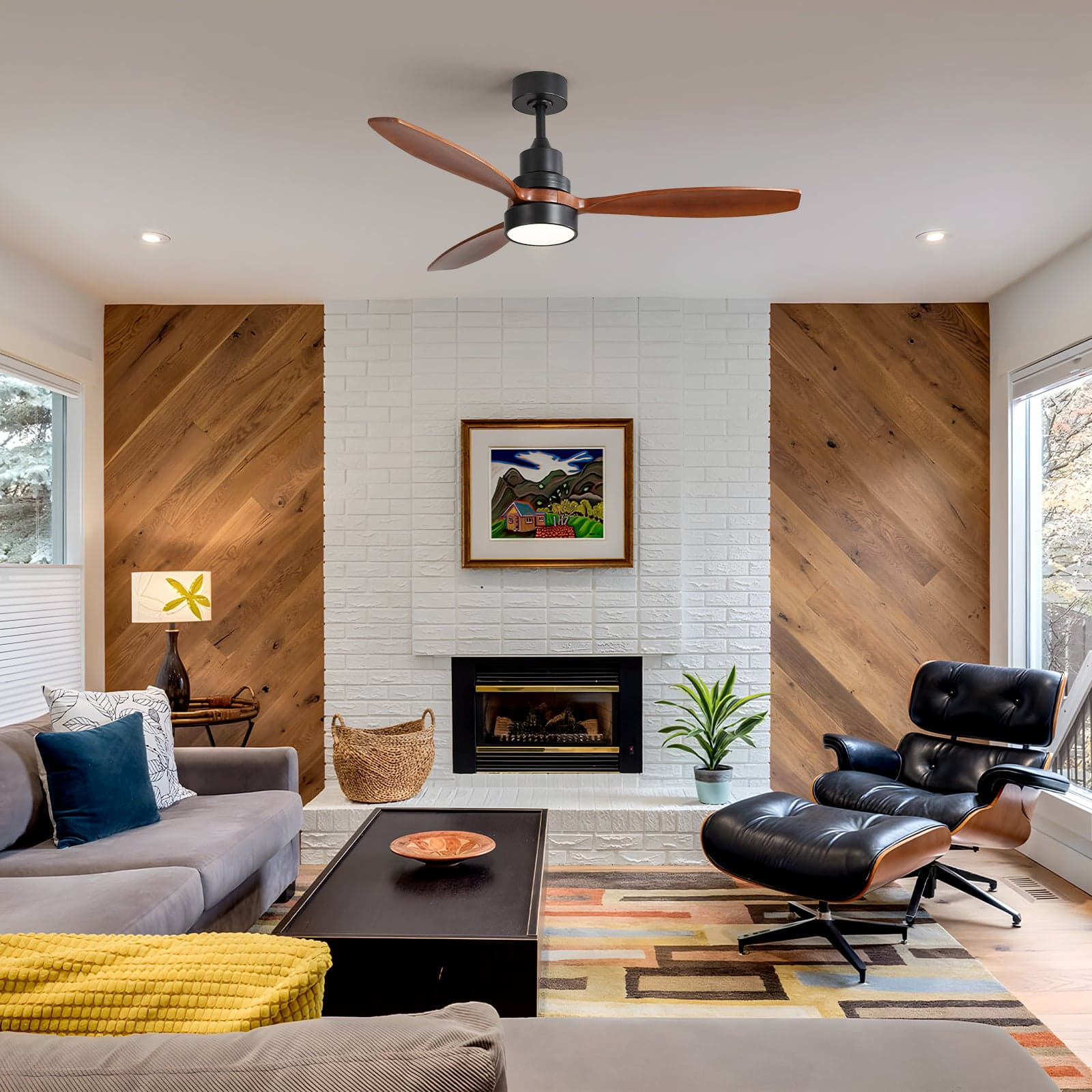
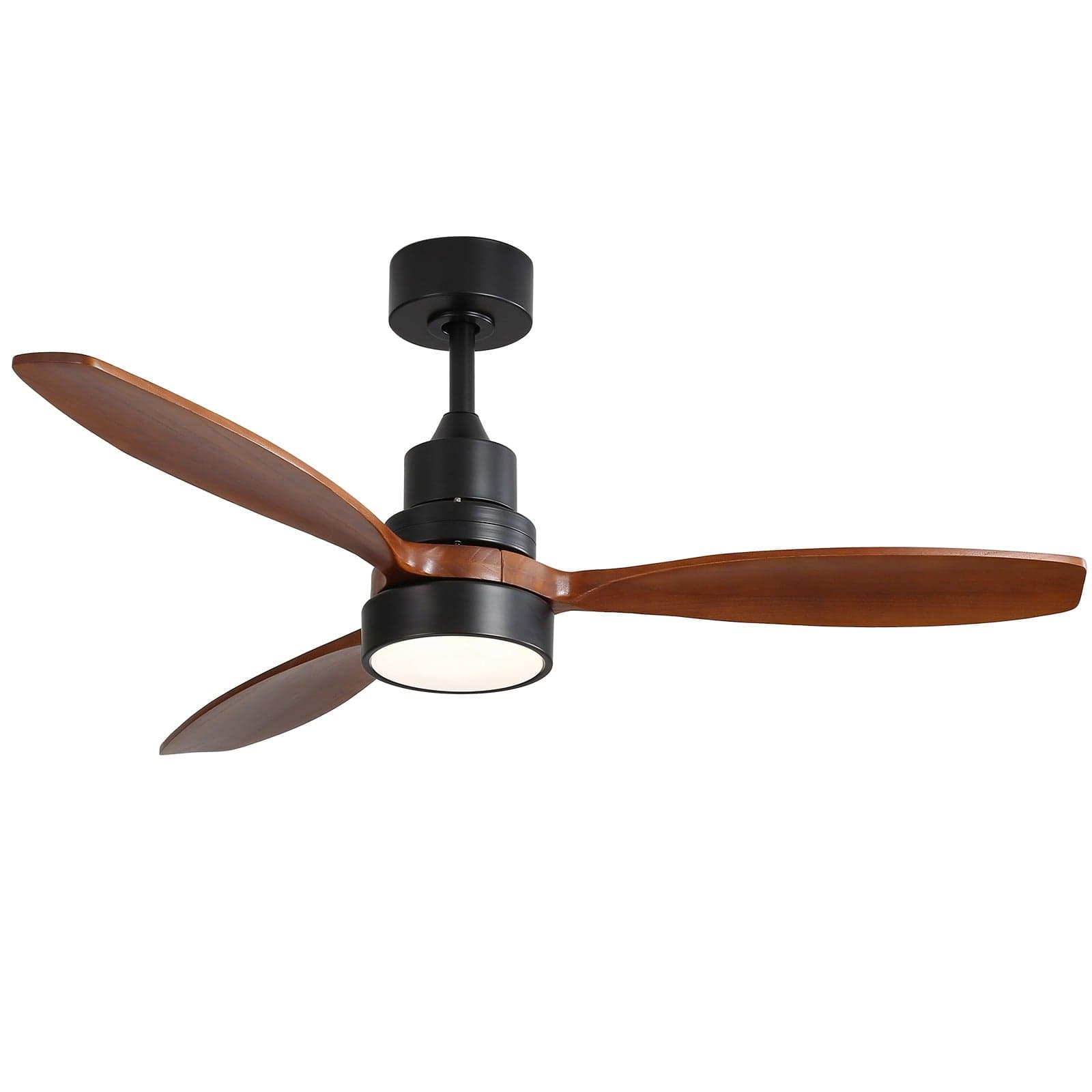
The Héritage 132
Solid walnut · Ø 132 cm · LED & reversible DC motor
- ✓Three carved solid-walnut blades: the warmth of wood on your ceiling
- ✓Low-consumption DC motor, 70% more efficient than AC
- ✓Reversible: cools in summer, spreads heating in winter
€399€499
Everyday comfort: speeds, reversibility, transitions
In daily use, the DC motor stands out through the fineness of its control. Where an AC motor classically offers three widely spaced settings, a DC motor provides six speeds, from an imperceptible night-time breeze to vigorous airflow for a heatwave. That granularity genuinely changes the experience: you always find the exact setting that cools without ever bothering, instead of oscillating between 'not enough' and 'too much'.
Two refinements specific to DC electronics complete the picture. First, reversibility: one press on the remote reverses the rotation for winter mode, which redistributes the warm air accumulated at the ceiling throughout the room. Second, progressive transitions: the motor accelerates and decelerates smoothly, with no mechanical jolt or relay clack, a detail that contributes to the overall impression of quality and matters when the fan stops in the middle of the night.
- ·Six speeds on a DC motor, from imperceptible night airflow to heatwave circulation
- ·Reversible winter mode: warm air accumulated at the ceiling is redistributed through the room
- ·Smooth starts, speed changes and stops, without jolts
Lifespan and reliability: the honest match
Let us be honest: on raw reliability, the AC motor has nothing to be ashamed of. Its mechanical simplicity, free of power electronics, makes it practically indestructible; some AC fans have been running for decades with no maintenance beyond dusting. It is also cheaper to build, therefore cheaper to buy, which remains a valid argument for a secondary room.
The DC motor carries more sophisticated electronics, a transformer and a control circuit, which by nature adds a point of complexity. On a well-engineered fan, that electronics is sized to last and works all the more gently because it runs cool, precisely thanks to the low power drawn. Build quality and warranty make the difference here: SEY Maison fans are covered by a 2-year warranty with European after-sales service, enough to remove any hesitation about the electronic side.
Cost over a summer and the verdict by usage
Take a typical summer: 8 hours of use per day for 4 months, about 122 days, at an electricity price of around 0.25 euros per kWh. An AC fan running at 75 W consumes about 72 kWh, that is 18 to 20 euros for the season. A DC fan at 20 W consumes about 19 kWh, roughly 5 euros. The gap, some fifteen euros per summer per fan, gradually offsets the DC premium, especially if the fan also serves in mid-season and in winter mode. For perspective, a split air conditioner would represent about 960 kWh over the same summer, 240 to 265 euros.
The verdict therefore follows usage. For a bedroom, the DC motor is unquestionably the right choice: very low speeds, minimal vibration, whisper-level quiet. For a pass-through room, a hallway or a utility room where the fan runs an hour here and there, an AC motor remains an acceptable and budget-friendly choice. For intensive use, a living room occupied all day, home office, hot climate, DC wins again: that is where the energy savings and the control comfort weigh the most.
- ·Bedroom: DC motor, for silent low speeds and the absence of vibration
- ·Pass-through room: AC motor acceptable, simple and cheaper to buy
- ·Intensive or daily use: DC motor, maximum energy savings and control comfort
The AC motor offers simplicity and robustness; the DC motor brings the frugality, the silence and the fineness of control that turn a ceiling fan into equipment you forget about, in the best sense. That is the conviction behind our collection: every model carries a reversible DC motor, like the Heritage 132 with its three solid walnut blades, 35 dB at most and dimmable LED lighting, for 329 euros.
Frequently asked questions
What is the difference between an AC and a DC motor on a ceiling fan?+
An AC motor runs directly on mains alternating current: simple and robust, but with coarse control and a high draw of 50 to 100 W. A DC motor converts the current via an electronic transformer, enabling fine speed control, a draw of 5 to 30 W and quieter operation.
Does a DC ceiling fan really use less electricity?+
Yes, the gap is structural: 5 to 30 W for a DC motor versus 50 to 100 W for an AC motor at comparable airflow, roughly 70% savings. Over a typical summer of 8 hours a day for 4 months, that means about 5 euros of electricity for a 20 W DC fan versus 18 to 20 euros for a 75 W AC fan.
Is a DC motor quieter than an AC motor?+
Yes. The DC motor's electronic control delivers steady torque with less vibration than an AC motor, and it reaches very low speeds an AC motor cannot hold cleanly. That is what allows SEY Maison models to run between 28 and 34 dB, whisper territory, ideal at night.
Which motor should I choose for a bedroom?+
A DC motor, without hesitation. Its very low speeds produce a barely perceptible airflow, its vibrations are minimal and its speed transitions are smooth. An AC motor, more prone to vibration and limited to widely spaced settings, is better suited to a pass-through room than a bedroom.
The SEY Maison Circle
Every month, an exceptional piece. Never reissued.
The Drops principle: one high-end furniture piece per month, in a numbered edition. Once it's gone, it never comes back. Circle members are notified 48 h early, access each drop 24 h before everyone else, and receive our guides before publication.
Discover the Drops →