Comparisons & guides
What ceiling fan size for a 320 sq ft (30 m²) room? The size guide
Published on ·4 min read
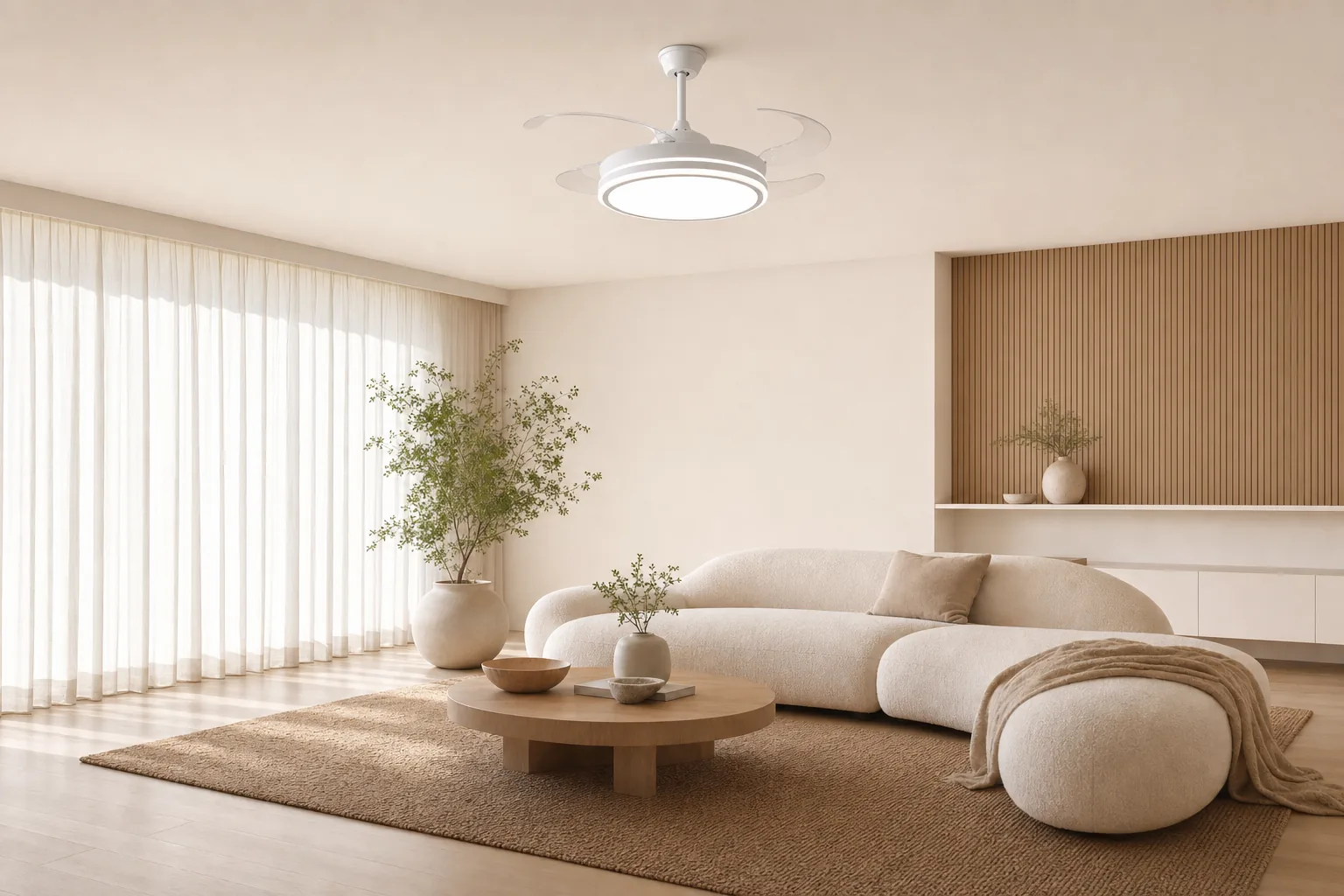
Diameter is the first criterion when buying a ceiling fan, before design and even before the motor. A beautiful but undersized model only creates a local draft under its blades; a properly sized one moves the entire air volume, silently. For 30 m², the short answer: 132 to 152 cm, with the balance point around 142 cm.
This guide walks through the size chart, explains why undersizing is the most common buying mistake, and focuses on the 25-35 m² range where most living rooms sit.
Why does diameter come before every other criterion?
A ceiling fan does not cool the air, it moves it. Moving air on the skin lowers perceived temperature by 3 to 4°C, and the area actually swept depends directly on blade span: a 107 cm fan covers 15 m² effectively, not 30.
Diameter also sets the operating regime. A larger fan moves more air per revolution, reaching the same airflow at half the speed. Fewer revolutions means less noise, less wear and a gentler, room-wide flow you can leave on all day.
The size chart: which diameter for which room?
Manufacturers and electricians converge on a simple floor-area chart that prevents most buying mistakes. If the room opens onto a kitchen or hallway, size up one step; if the fan serves one specific zone, center it over that zone rather than the room.
- ·Under 10 m² (office, child's room): 76 to 91 cm
- ·10 to 15 m² (bedroom, closed kitchen): 91 to 107 cm
- ·15 to 25 m² (large bedroom, compact living room): 107 to 132 cm
- ·25 to 35 m² (living room, open living area): 132 to 152 cm
- ·Above 35 m² (loft, great room): 152 to 178 cm, or two fans
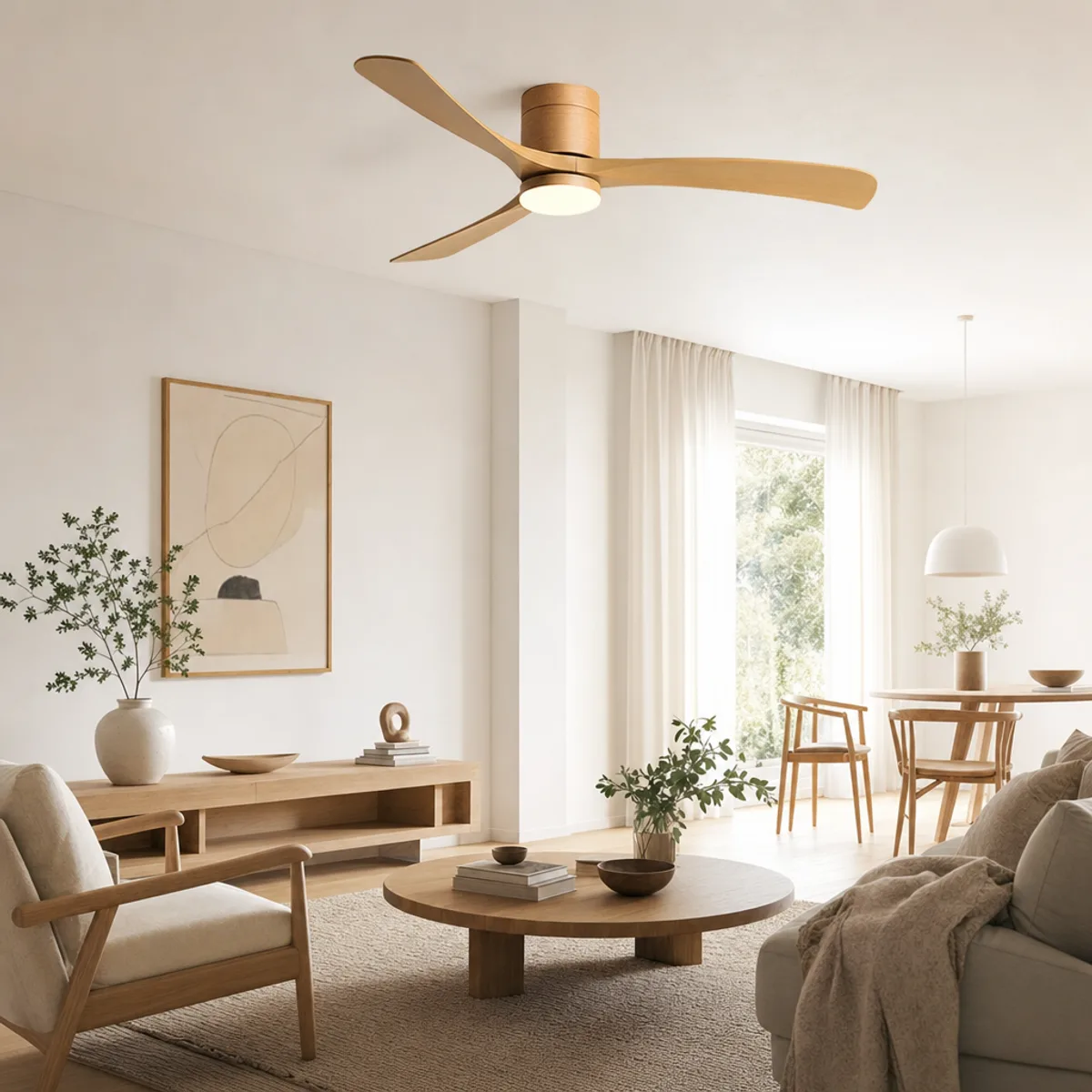
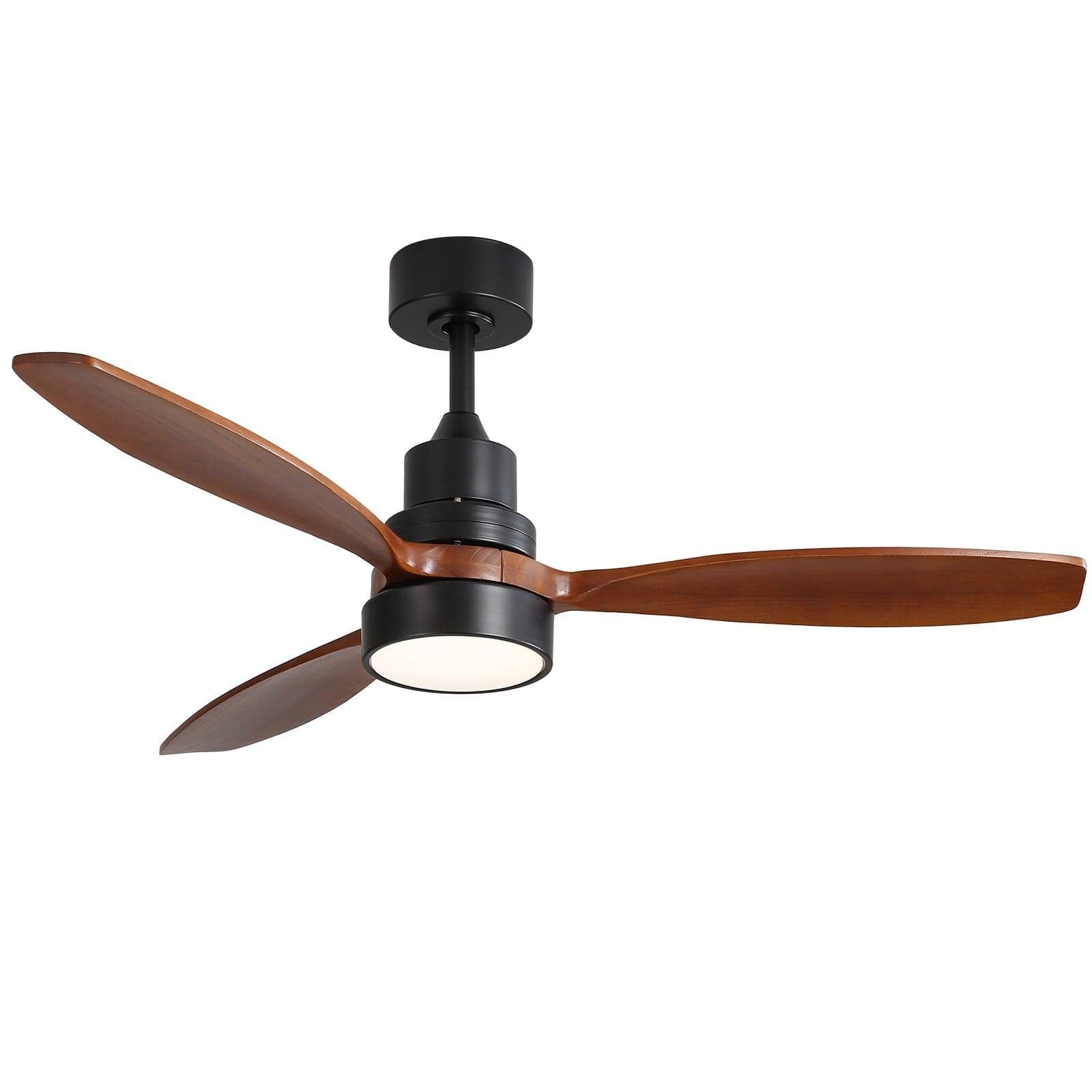
The Épicéa 142
Wood body & wood blades · Scandinavian · Integrated LED
- ✓Silent DC motor, 6 reversible speeds
- ✓Integrated dimmable LED + remote control
- ✓30-minute installation, illustrated manual
US$539
The 25-35 m² case: why 142 cm is the pivot format
30 m² is the hinge surface: too large for standard 107-122 cm fans, not vast enough for a 178 cm giant. The 132-152 cm range applies, and 142 cm sits exactly at its center: enough span to cover the whole room at low speed, enough restraint not to overwhelm a standard ceiling.
That is the format of a model like the Épicéa 142: a 142 cm span, body and blades clad in light wood in a Scandinavian spirit, integrated dimmable LED and a reversible DC motor with 6 remote-controlled speeds. In a 30 m² living room it runs on low speeds most of the year, inaudible, with reserve for heat peaks.
Undersizing: the mistake that costs both comfort and silence
Undersizing is the most common buying error because a small diameter looks more discreet and often costs less. The result is systematic: air circulates only in a narrow cylinder under the fan, the rest of the room feels nothing, and you compensate with speed, hence noise.
The symptoms are unmistakable: you need to stand under the fan to feel anything, maximum speed has become the default, and air hiss has replaced the promised silence. A slightly oversized fan has none of these flaws: on speed 1 or 2 it stirs the whole room at 28-34 dB. When hesitating between two sizes, take the larger one.
Height and placement: the two checks before buying
Keep at least 2.10 m between floor and blades: with a 2.50 m ceiling every format fits, at 2.40 m choose flush-mounted profiles. Keep around 50 cm or more between blade tips and any wall so the flow develops without turbulence.
Think year-round too: a reversible DC motor offers a winter mode that gently pushes ceiling-trapped warm air back down. Over 30 m², this often lets you lower the heating by a degree.
For 30 m², the decision fits in one line: a 132 to 152 cm diameter, ideally 142 cm, centered over the living zone with 2.10 m under the blades. A model like the Épicéa 142 ticks the full grid: the exact span for this surface, a silent reversible DC motor, a dimmable LED replacing the ceiling light, a remote and a 2-year warranty. The right diameter is what separates a local draft from a genuine comfort system.
Frequently asked questions
What ceiling fan diameter for a 30 m² living room?+
Between 132 and 152 cm, ideally around 142 cm. That span covers the whole surface at low speed, hence silently. Below 132 cm the flow stays concentrated under the fan and you compensate with speed and noise.
Is it better to oversize or undersize a ceiling fan?+
Oversize, without hesitation. A large diameter at low speed moves more air than a small one at full speed, staying under 34 dB. The only hard limits are physical: 2.10 m between floor and blades, about 50 cm between blades and walls.
Is one fan enough for an L-shaped or open-plan room?+
One properly sized fan is enough if the main living zone is compact. Beyond 35-40 m² or in a pronounced L-shape, two medium fans centered on each zone give more even comfort than a single off-center giant.
The SEY Maison Circle
Every month, an exceptional piece. Never reissued.
The Drops principle: one high-end furniture piece per month, in a numbered edition. Once it's gone, it never comes back. Circle members are notified 48 h early, access each drop 24 h before everyone else, and receive our guides before publication.
Discover the Drops →