Silence & sleep
The decibel scale explained: everyday examples that make it click
Published on ·4 min read
The decibel is the most quoted and least understood unit in everyday life. The confusion comes from one fact: the decibel scale is logarithmic, not linear. Once that principle is clear, everything else falls into place.
This guide demystifies the scale with concrete domestic examples. You will understand why a 55 dB air conditioner is not 'just a little louder' than a 30 dB whisper, it is several times more intense, and what that means for your bedroom, your health, and your equipment choices.
Why the scale is logarithmic: the simple explanation
Every 10 dB increase represents a tenfold increase in physical sound intensity, and a doubling of perceived loudness. So 60 dB is not 'twice as loud' as 50 dB because the numbers differ by 20%, it is because the physical intensity is ten times higher, which the brain interprets as twice as loud.
This has a direct practical consequence: reducing a sound from 50 dB to 40 dB is not 'taking a little away', it is dividing the intensity by ten and halving the perceived loudness. Conversely, adding a second identical appliance only raises the level by 3 dB, barely perceptible.
- ·+3 dB: double the physical intensity (two identical appliances), barely noticeable
- ·+10 dB: ten times the intensity, perceived as twice as loud
- ·+20 dB: one hundred times the intensity, perceived as four times as loud
The scale illustrated: everyday benchmarks
These values are measured in dB(A), the A-weighted decibel, which matches human hearing sensitivity by attenuating very low and very high frequencies.
- ·30 dB: whisper at 1 m, silent ceiling fan, countryside at night (WHO bedroom recommendation)
- ·40 dB: quiet library, refrigerator hum, micro-arousal threshold in sensitive sleepers
- ·50 dB: moderate rain, low-activity open-plan office
- ·55 dB: domestic air conditioning, quiet conversation in adjacent room
- ·60 dB: normal conversation at 1 m, calm restaurant
- ·70 dB: vacuum cleaner, dishwasher, moderate urban traffic
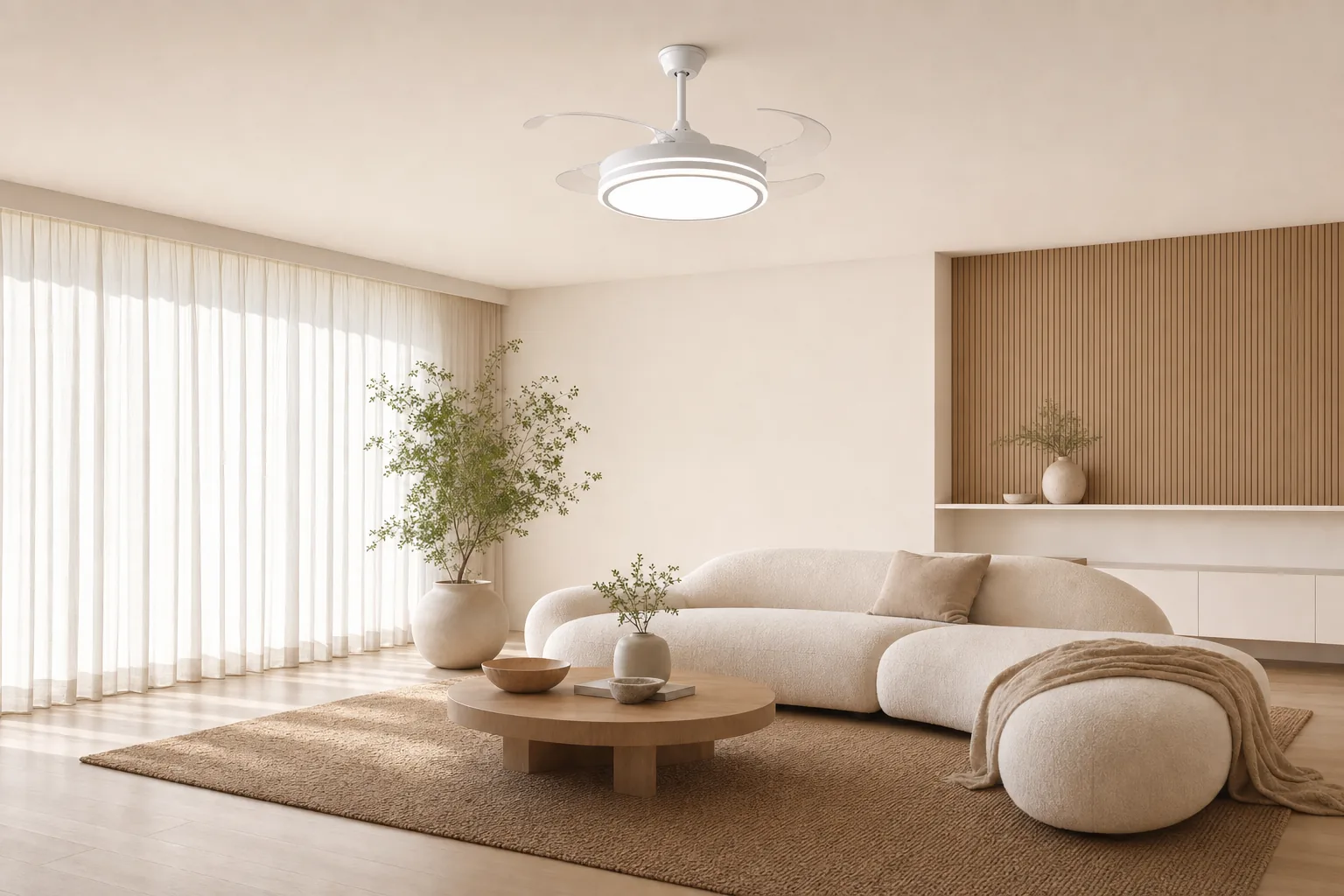
The Boréal 107
Retractable blades · Ø 107 cm · LED ceiling light & silent fan
- ✓Retractable blades: invisible when off, nobody guesses it's a fan
- ✓Sleep with windows closed, 30 dB, quieter than a whisper
- ✓Integrated LED 2700K → 6000K, dimmable: replaces your ceiling light
What the scale means for equipment choices
Comparing a 40 dB fan with a 30 dB one may seem trivial, just 10 dB. In reality, the 30 dB unit is ten times less physically intense and perceived as twice as quiet. Over eight hours of sleep, that difference is decisive: one fragments deep sleep, the other disappears into the ambient silence.
The same logic applies to comparing fans and AC. A 55 dB air conditioner is about 32 times more intense than a 30 dB silent fan, and perceived as five times louder. That is not 'slightly noisier'. It is an entirely different acoustic category.
The traps in product noise communication
Spec sheets often hide important caveats. The first trap: measurements in an anechoic chamber versus a real room. A real bedroom reflects sound, the perceived level is always higher than the lab value. A 28 dB(A) anechoic result can easily become 33-35 dB(A) in your room.
The second trap: measurement speed. A fan advertised as '25 dB' may only achieve that at minimum speed, climbing to 45 dB at normal speed. Always check at which speed the measurement was made.
The decibel scale is logarithmic, making every decibel gained genuinely valuable. Moving from 55 to 30 dB in a bedroom is not a minor detail, it multiplies perceived quietness by more than five and restores the conditions deep sleep requires. That is the target our DC ceiling fans were designed to meet: 30 dB on night speed, measured under realistic conditions.
Frequently asked questions
Why do people say +10 dB sounds twice as loud?+
+10 dB means ten times more physical sound intensity. Human hearing compresses this progression so that physical intensity must roughly multiply by ten for perceived loudness to double. The rule holds as a good approximation between 40 and 80 dB.
What is the difference between dB and dB(A)?+
Plain dB measures all frequencies equally. dB(A) weights the signal to match human hearing sensitivity, which is most acute between 1,000 and 4,000 Hz. For assessing the actual nuisance of a domestic appliance, dB(A) is always the relevant reference.
At what level does sound start damaging hearing?+
Hearing risk begins around 85 dB(A) for prolonged exposure (8 hours per day under occupational standards). Typical domestic sounds, conversation, normal TV, ceiling fan, are far below this threshold. At home, the issue is comfort and sleep, not hearing damage.
The SEY Maison Circle
Every month, an exceptional piece. Never reissued.
The Drops principle: one high-end furniture piece per month, in a numbered edition. Once it's gone, it never comes back. Circle members are notified 48 h early, access each drop 24 h before everyone else, and receive our guides before publication.
Discover the Drops →