Silence & sleep
White noise for sleep: does a ceiling fan really help?
Published on ·4 min read
The phenomenon is real and documented: millions of people worldwide fall asleep more easily with the continuous hum of a fan in the background. This is not superstition, it is acoustic physics and neuroscience. But as with most things related to sleep, the details matter: at what level? What type of sound? And are there conditions under which it becomes counter-productive?
This guide reviews what science currently knows about white noise and sleep, with particular focus on the fan, the most common, quietest and most naturally integrated bedroom white-noise generator.
What is white noise and why does it aid sleep?
White noise is an audio signal containing all audible frequencies in equal proportion, from 20 Hz to 20,000 Hz, all equally represented. Its utility for sleep rests on two complementary mechanisms. The first is sound masking: a continuous background makes unpredictable sound spikes, voices in the hall, a car outside, a slamming door, less salient relative to the baseline. The contrast between background and spike is compressed.
The second mechanism is neurocognitive: a stable, continuous sound occupies a fraction of the brain's auditory processing bandwidth, leaving fewer cognitive resources available to process intrusive stimuli. In simple terms: your brain, mildly occupied by the continuous sound, is less reactive to alerting sounds.
- ·Sound masking: continuous baseline compresses the salience of unexpected sound spikes
- ·Reduced cognitive vigilance: the brain processes fewer spurious alerts
- ·Pavlovian conditioning: for regular users, the sound becomes a sleep-onset cue
White, pink, brown noise: which is best for sleep?
Pink noise contains all frequencies but with decreasing energy at higher frequencies (-3 dB per octave). The result is a softer, deeper sound many describe as resembling rain or a waterfall. Studies suggest pink noise synchronised with deep sleep oscillations may improve memory consolidation. Brown noise, even deeper, resembles strong wind or powerful waves.
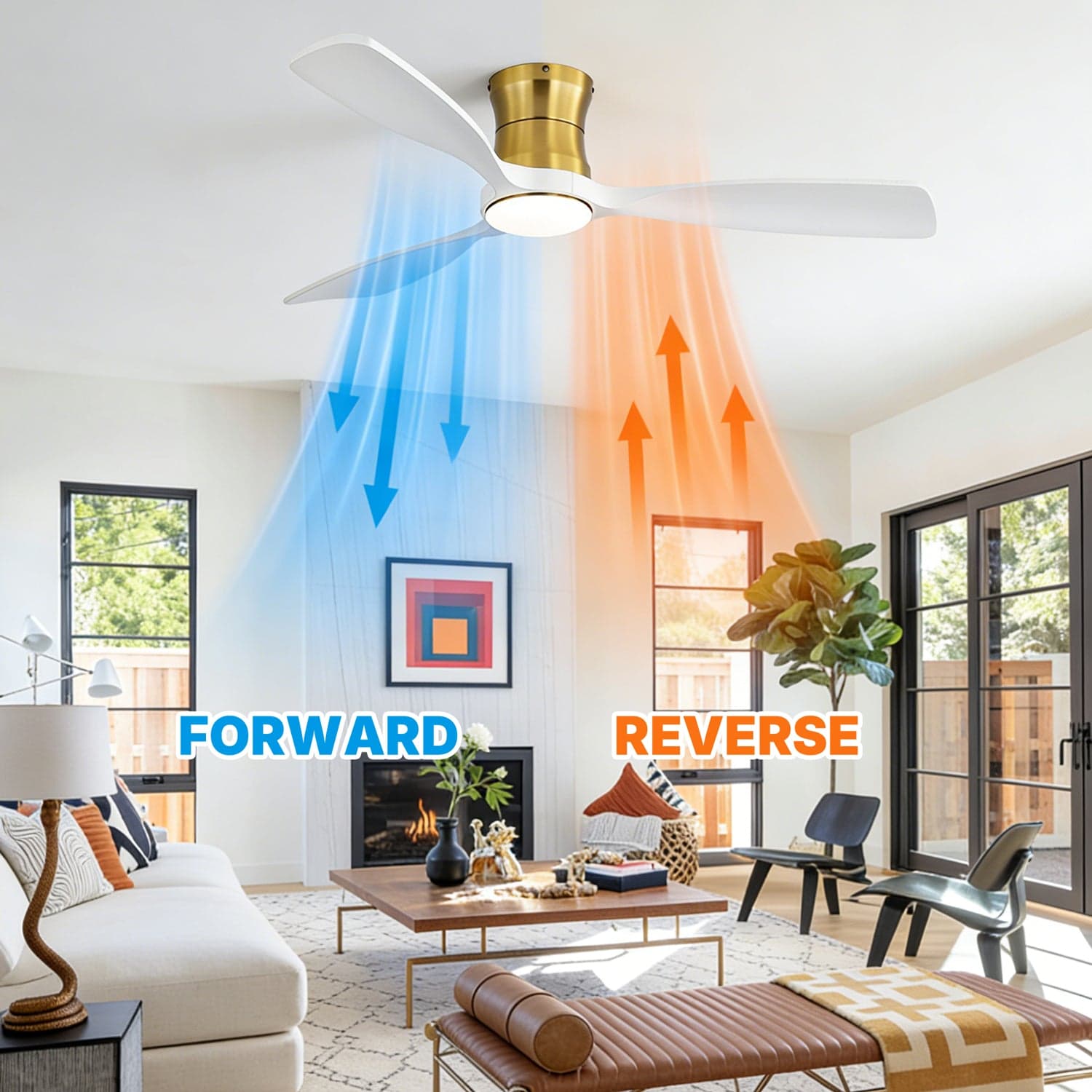
In practice, a ceiling fan generates a composite of white, pink and brown noise, with a low-frequency component from the motor and blades, and a higher-frequency component from air movement. This composite spectrum is often described as the most pleasant to the ear, precisely because it is not purely white.
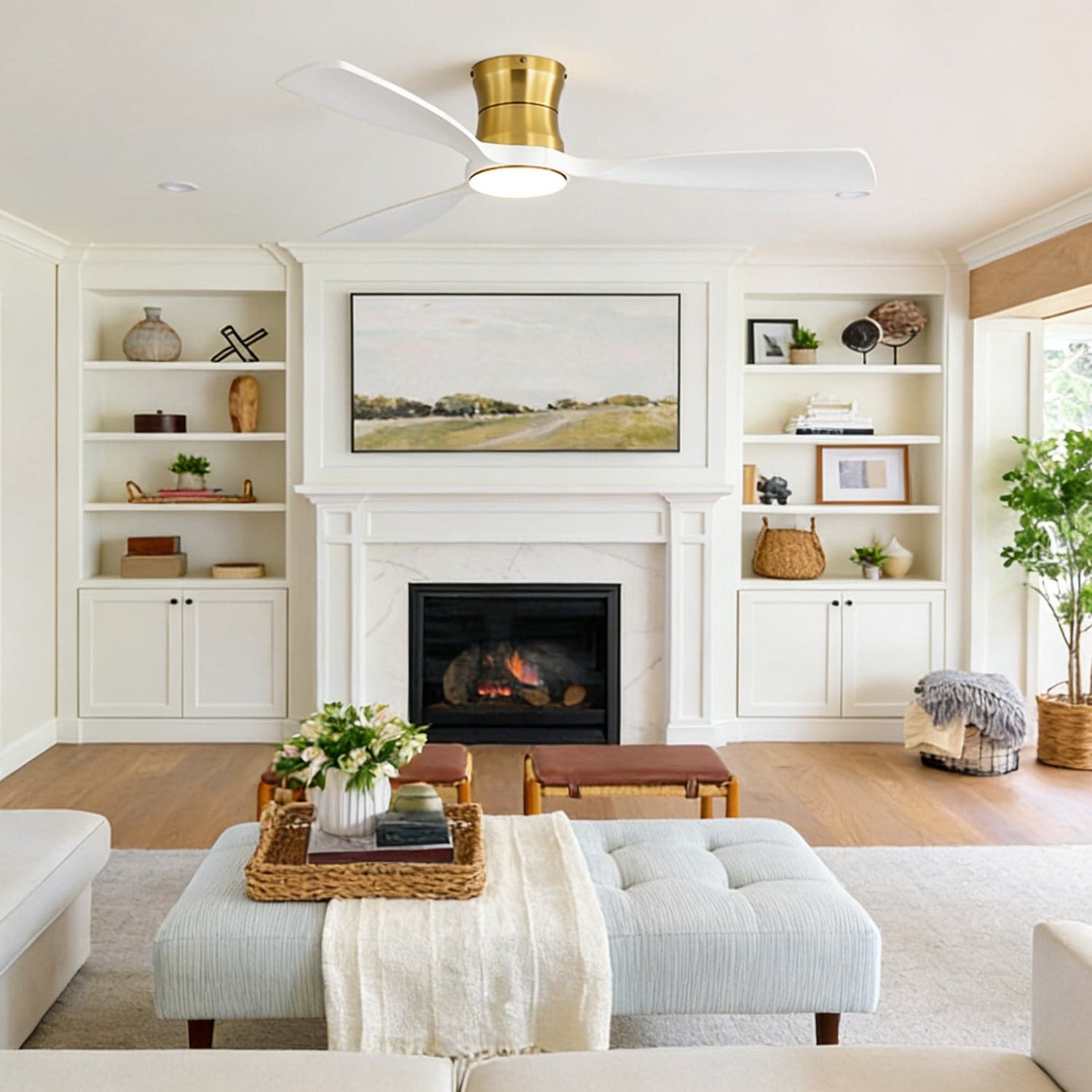
The Alma 122
Contemporary design · Ø 122 cm · LED & remote
- ✓Clean contemporary design, three curved blades
- ✓The best value in the collection
- ✓Dimmable LED, 3 temperatures + remote
€279€349
Best practices: level, duration, type of fan
The optimal masking level for sleep sits around 40 to 50 dB according to the literature, loud enough to mask external spikes, not loud enough to itself become a nuisance. But this must be weighed against the WHO recommendation: below 30 dB at night in the bedroom for long-term health.
The pragmatic recommendation: if your environment is quiet (below 40 dB ambient), a ceiling fan at 30 dB on night speed is sufficient, it creates the stable background that conditions sleep onset without masking anything significant. If your environment is noisy, 40-45 dB may be justified temporarily, with the goal of returning to 30 dB as soon as possible through other measures.
- ·30 dB: ideal in quiet environments, WHO-compliant, effective air circulation
- ·40-45 dB: effective masking in moderate urban environments, acceptable short-term
- ·50 dB and above: strong masking, possible micro-arousals, avoid long-term
When white noise becomes counter-productive
White noise is not universal. For an estimated 10-15% of sleepers, any continuous background sound maintains vigilance rather than reducing it. These people find complete silence more conducive to sleep. If you are in this group, white noise is not the solution.
A second limitation is conditioning: regular users can develop a functional dependency and struggle to fall asleep without it. This is not a problem if the sound source is always available (a ceiling fan at home), but it can become a constraint when travelling. The recommendation is to use white noise as a tool, not a crutch, ensuring other sleep parameters (temperature, darkness, regular schedule) are also managed.
A fan's white noise genuinely helps roughly two-thirds of sleepers, through sound masking and reduced cognitive vigilance. The optimal level is around 30 to 40 dB, a ceiling our DC-motor ceiling fans respect on night speed. The ceiling fan's advantage over mobile apps: it circulates air simultaneously, presents no algorithmic peaks, and runs at a stable low level all night.
Frequently asked questions
Is a fan's white noise really effective for sleep?+
Yes, for the majority of sleepers. The main mechanism is sound masking: the continuous background makes unexpected sound spikes less salient and less likely to trigger micro-arousals. For the 10-15% of people who find any background sound disturbing, complete silence remains the best option.
What is the difference between white, pink and brown noise for sleep?+
White noise contains all frequencies at equal intensity (hissing). Pink noise has less energy in the high frequencies (resembles rain). Brown noise is even deeper (strong wind). Studies suggest pink noise may slightly improve memory consolidation during deep sleep. A ceiling fan naturally generates a mix of all three, often described as the most pleasant.
At what volume should white noise be used for sleep?+
The literature places optimal masking around 40-50 dB. But the WHO recommendation for long-term health is to stay below 30 dB in the bedroom. Practical recommendation: use the minimum effective level, often 30 dB if the environment is naturally calm.
The SEY Maison Circle
Every month, an exceptional piece. Never reissued.
The Drops principle: one high-end furniture piece per month, in a numbered edition. Once it's gone, it never comes back. Circle members are notified 48 h early, access each drop 24 h before everyone else, and receive our guides before publication.
Discover the Drops →