Cooling without AC
Portable air conditioner or ceiling fan: the honest summer showdown
Published on ·8 min read
Every heatwave triggers the same reflex: rushing to the nearest store for a portable air conditioner, typically 300 to 700 euros, often the last one on the shelf. It is the number one impulse purchase of hot summers, and statistically one of the most disappointing. Noisy, heavy, power-hungry, and condemned to exhaust its hot air through a partly open window that lets back in the very heat it is fighting: the monobloc design carries structural handicaps that no model, however premium, can truly overcome.
The ceiling fan plays a different game altogether: it does not chill the air, it cools people, with an immediate perceived drop of 3 to 4 degrees, a 28 to 34 dB hush and a negligible power draw. This honest comparison walks through noise, real-world effectiveness, floor space, consumption and the cost of a full summer of use, without dodging the situations where air conditioning, portable or split, remains the right call.
The heatwave impulse buy: why portable ACs disappoint so often
The portable air conditioner sells a seductive promise: real air conditioning, no installation, plugged in within five minutes. The trouble is that this promise rests on a physical contradiction. An air conditioner works by moving heat from one side of a wall to the other: a split system places its compressor and heat rejection outside, while a monobloc keeps everything inside the room, including the hot half of the machine. It must therefore push that heat out through a hose, across a window that can never be fully closed.
The result: the machine partly reheats the room it is cooling, draws in air it has already cooled only to blow it outdoors, and creates negative pressure that pulls warm outdoor air back in through the cracked window and every gap in the room. Real-world efficiency is structurally poor, far below a split system. Many buyers discover this on the first night: the room barely cools, slowly, and the unit runs non-stop to hold on to that meagre difference.
Noise: 55-65 dB in your room versus 28-34 dB
This is the most underestimated difference at purchase, and the most regretted afterwards. A portable AC carries its compressor into the very room where you seek rest: expect 55 to 65 dB in operation, the level of a lively conversation, topped by compressor on-off cycles that fragment sleep. A split system does better (40 to 55 dB indoors) because its compressor lives outside; the monobloc has nowhere to hide its own.
A silent ceiling fan runs between 28 and 34 dB, the level of a whisper. Because the decibel scale is logarithmic, the gap is not 'a bit more noise': between 30 and 60 dB, physical intensity multiplies a thousandfold and perceived loudness roughly quadruples. In practice, one disappears into the silence of a bedroom at night; the other can be heard from the next room. For sleeping, the matter is settled before temperature even enters the discussion.
- ·Portable AC: 55-65 dB, compressor in the room, on-off cycling
- ·Split air conditioning: 40-55 dB indoors, compressor outside
- ·SEY Maison ceiling fan: 28-34 dB, steady continuous airflow
Real-world effectiveness: leaking cold air versus instant relief
On paper, the air conditioner lowers air temperature and the fan does not: advantage AC. In practice, the monobloc pays dearly for its hose. The partly open window lets warm air stream in continuously, the hose itself radiates heat into the room, and the unit fights against calories it is itself letting in. It often takes hours to gain a few degrees in an average room, and the gain vanishes the moment a door opens.
The ceiling fan does not cool the air: it accelerates the evaporation of perspiration at the skin's surface, lowering perceived temperature by 3 to 4 degrees, instantly, from the moment it starts. No ramp-up, no room to seal, no losses: the effect arrives within seconds and covers the whole area swept by the airflow, an entire room for a 107 cm diameter like Le Boréal's. At 30 degrees, a perceived 26-27 degrees transforms an evening; that is precisely the margin most households are actually looking for.
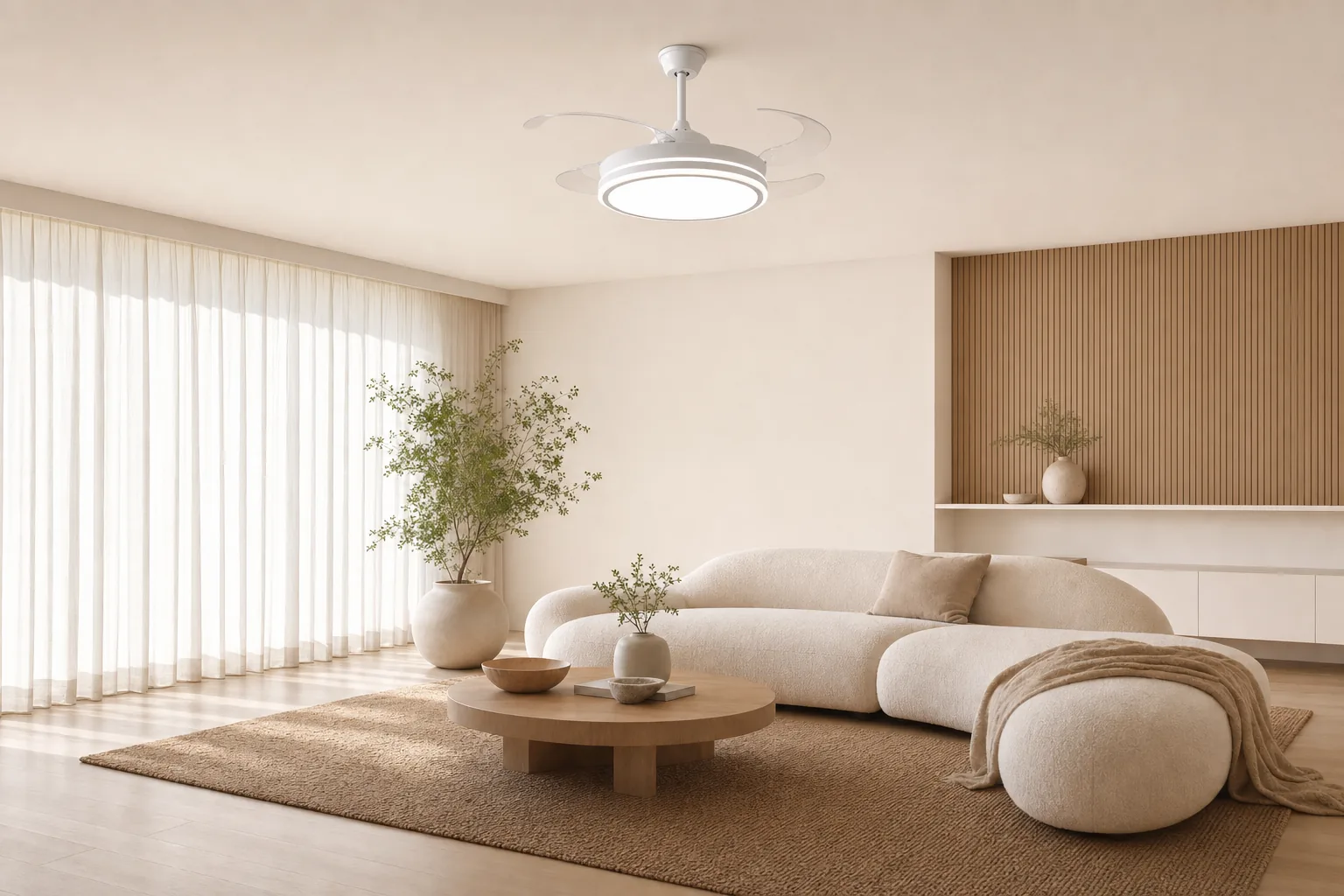
The Boréal 107
Retractable blades · Ø 107 cm · LED ceiling light & silent fan
- ✓Retractable blades: invisible when off, nobody guesses it's a fan
- ✓Sleep with windows closed, 30 dB, quieter than a whisper
- ✓Integrated LED 2700K → 6000K, dimmable: replaces your ceiling light
Footprint and looks: 30-40 kg on the floor versus zero
A portable air conditioner is a 30 to 40 kg box parked in the middle of the room, a ten-centimetre hose snaking to the window, and a window locked in a half-open position with its zipped fabric sealing kit. 'Portable' is generous: you can wheel it from room to room provided each stop has a compatible window. Come winter, it needs a cupboard of its own. Aesthetically, no considered interior comes out ahead.
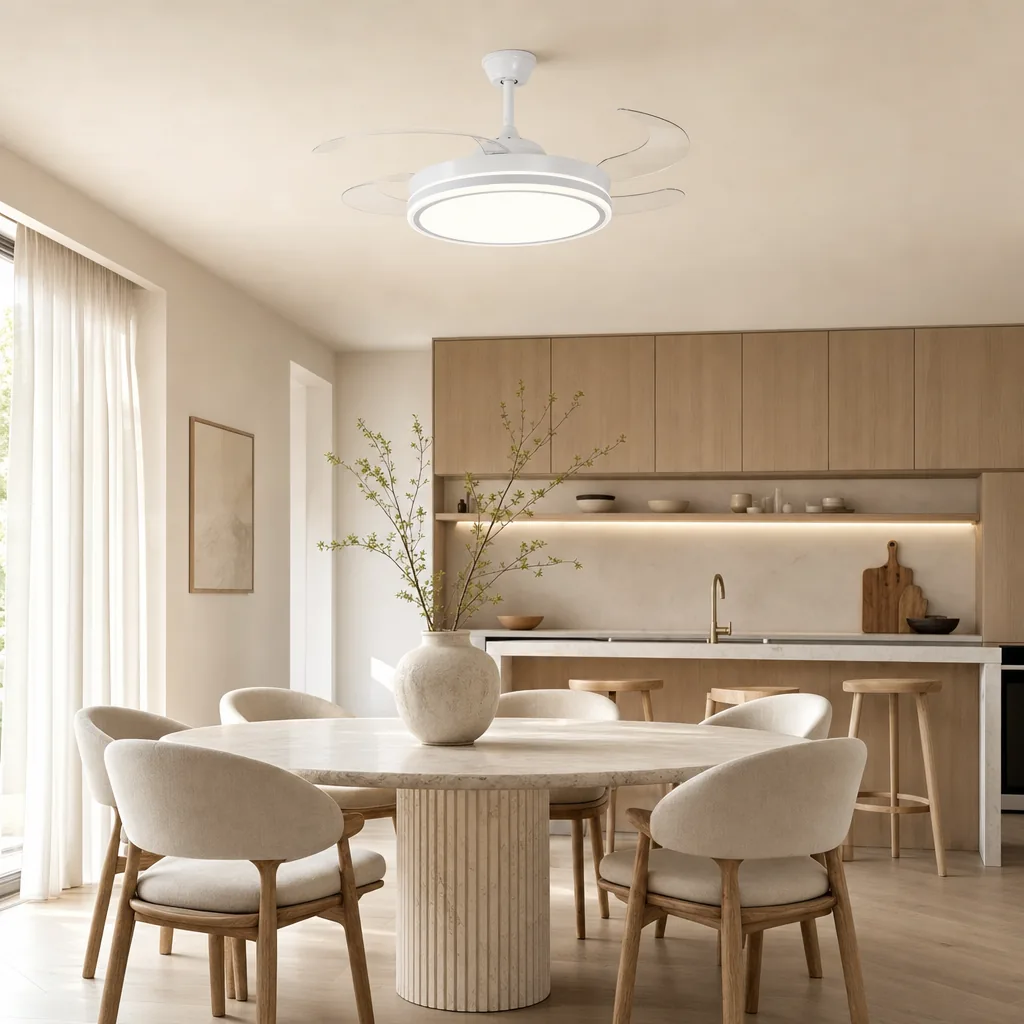
The ceiling fan occupies the only unused space in the home: the ceiling. Zero floor footprint, no hose, windows free, nothing to store off-season. Installed in 30 minutes on an existing light fixture point, it replaces the central pendant while adding dimmable LED lighting. A retractable-blade model like Le Boréal 107 takes the logic to its conclusion: blades extended when moving air, folded into a discreet pendant the rest of the time. It is an object chosen as much for what it brings to a room as for what it blows.
Power draw and running cost: the maths of one summer
In operation, a portable AC draws around 1,000 to 1,500 W. At the pace of a hot summer, 8 hours a day for four months, that amounts to 960 to 1,440 kWh. For reference: a split air conditioner uses roughly 960 kWh over the same summer, about 240 to 265 euros of electricity. The monobloc, with equal or higher consumption for an inferior result, lands at least in the same range, and often beyond, since it runs longer to compensate for its poor efficiency.
An AC-motor ceiling fan draws 50 to 100 W; a DC motor drops to 5 to 30 W depending on speed, ten to a hundred times less than a portable air conditioner. Over the same summer of 8 hours a day for four months, a DC model costs around 5 euros of electricity. Add the purchase price, 189 euros for Le Boréal 107 with its 2-year warranty, against 300 to 700 euros for a monobloc, and the economic duel is over within the first season: the fan costs less to buy and disappears from the power bill.
- ·Portable AC: ~1,000-1,500 W, 960 to 1,440 kWh per summer at 8 h/day
- ·Split air conditioning: ~960 kWh per summer, about 240-265 euros of electricity
- ·DC ceiling fan: 5 to 30 W, around 5 euros of electricity for the whole summer
When air conditioning remains the right choice
Honesty requires saying it: a fan does not lower air temperature, and some situations demand genuinely cold air. In extreme heatwaves, several days above 35 degrees with nights that never cool down, vulnerable people, infants, the elderly, the chronically ill, need at least one air-conditioned room. That is a public health matter, not a comfort preference, and in that scenario a properly installed split, or even a monobloc as a stopgap, provides a service no amount of airflow can replace.
Another legitimate case: rooms with no ceiling light point and no way to create one, or ceilings too low to respect safety clearances. There, a portable AC or a pedestal fan becomes a rational option again. For everything else, meaning the vast majority of European summers, where the goal is to live and sleep well between 26 and 34 degrees, the ceiling fan delivers a comfort-silence-cost balance the monobloc cannot approach. The two can even work together: air circulation lets you set an air conditioner 3 to 4 degrees higher for the same perceived comfort.
The portable air conditioner promises air conditioning without installation and mostly delivers its compromises: 55 to 65 dB in the room, a hose that ruins efficiency, 30 to 40 kg on the floor and a 1,000 to 1,500 W appetite. The ceiling fan makes no claim to chill the air; it delivers an immediate perceived drop of 3 to 4 degrees, in a 28 to 34 dB hush, for about 5 euros of electricity per summer in DC form. For extreme heatwaves and vulnerable people, air conditioning keeps its place. For every other summer, Le Boréal 107, retractable blades, dimmable LED, 189 euros and a 30-minute installation, is the purchase you will not regret come September.
Frequently asked questions
Are portable air conditioners actually effective at cooling a room?+
Only moderately. A monobloc exhausts hot air through a hose in a partly open window, which lets warm outdoor air flow back in continuously. Its real-world efficiency is well below a split system: the room cools slowly by a few degrees and the unit must run non-stop, at 55-65 dB, to hold that difference.
Which uses less power: a portable AC or a ceiling fan?+
The ceiling fan, by a wide margin. A portable air conditioner draws around 1,000 to 1,500 W in operation, versus 50 to 100 W for an AC-motor ceiling fan and 5 to 30 W for a DC motor. Over a summer of 8 hours a day for four months, a DC ceiling fan costs around 5 euros of electricity.
What is the best alternative to a portable air conditioner?+
For most summers, a silent ceiling fan: an immediate perceived cooling of 3 to 4 degrees, 28 to 34 dB, zero floor footprint and a 30-minute installation on an existing ceiling light point. Air conditioning (preferably a split system) remains relevant in extreme heatwaves or for vulnerable people.
Can you sleep with a portable air conditioner in the bedroom?+
Most sleepers find it difficult: the compressor sits inside the room and produces 55 to 65 dB, with on-off cycles that fragment sleep. A ceiling fan at 28-34 dB, below the 30 dB commonly recommended for bedrooms, accompanies the whole night without drawing attention to itself.
The SEY Maison Circle
Every month, an exceptional piece. Never reissued.
The Drops principle: one high-end furniture piece per month, in a numbered edition. Once it's gone, it never comes back. Circle members are notified 48 h early, access each drop 24 h before everyone else, and receive our guides before publication.
Discover the Drops →