Interior design
Designing a conservatory: how to make it liveable all year round
Published on ·4 min read
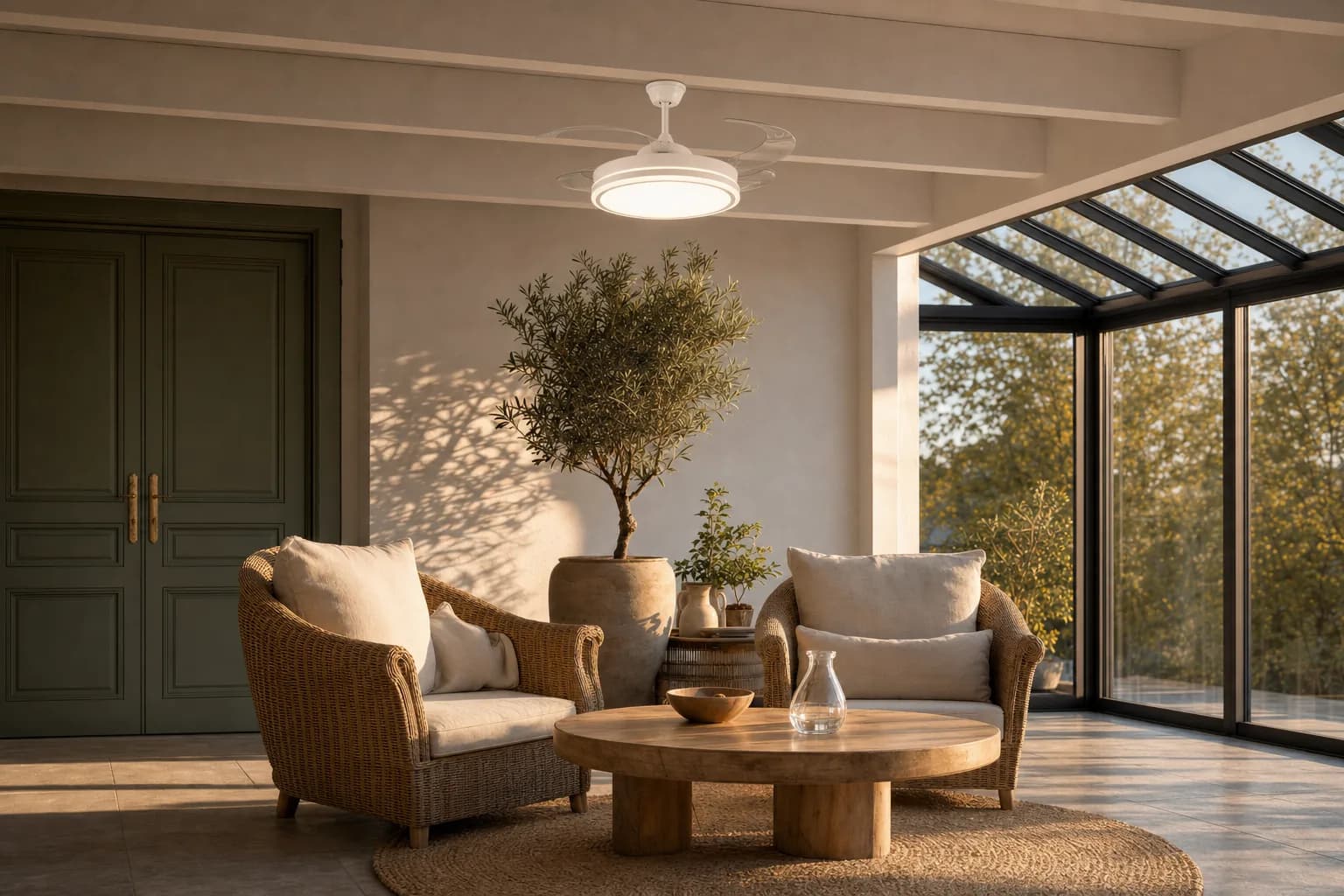
The conservatory is the most promising and most under-used room in the French home. Extraordinary in winter on a clear day, a greenhouse warmed by the sun, full of light, it often becomes uninhabitable by May: 40°C inside when it is 25°C outside, no air, no shade, no life. The result: a room closed for eight months of the year.
Transforming a conservatory into a four-season living space does not necessarily require major renovation. It requires understanding the physics of the space, how heat enters, how air circulates, how materials behave, and addressing it with layered solutions.
Understanding the thermal problem: why conservatories overheat
A conservatory is a greenhouse. Glazing lets in light (short wavelengths) and retains radiant heat (long wavelengths), the greenhouse effect. In summer, on a south or west orientation, an unprotected conservatory receives up to 800 W/m² of solar radiation. Heat accumulates rapidly and cannot escape without sufficient ventilation.
The solution is layered. Act on three levels simultaneously: block incoming radiation (shading), evacuate accumulated heat (ventilation), and absorb excess with high-inertia materials (stone floor, brick walls). Acting on one level alone improves; acting on all three transforms.
- ·Level 1: shading, stop radiation before it enters
- ·Level 2: ventilation, continuously evacuate accumulated heat
- ·Level 3: thermal inertia, buffer temperature peaks with dense materials
Shading solutions: blinds, awnings and solar films
External blinds are the most effective solution, they block radiation before it crosses the glazing. A correctly dimensioned external blind can reduce solar gain by 70 to 80%. Cassette awnings, tensioned shade sails, and bioclimatic pergolas with adjustable louvres are the most effective options. Internal blinds, by contrast, are almost thermally useless: they block light but not heat, which has already entered through the glazing.
For glazing that is difficult to fit with external blinds (sloped glass roofs), metallic deposition solar films (60-70% reflection) or ceramic films (high visible light transmission, infrared blocking) are an alternative. A quality film, professionally applied, reduces interior temperature by 5-8°C while preserving brightness.
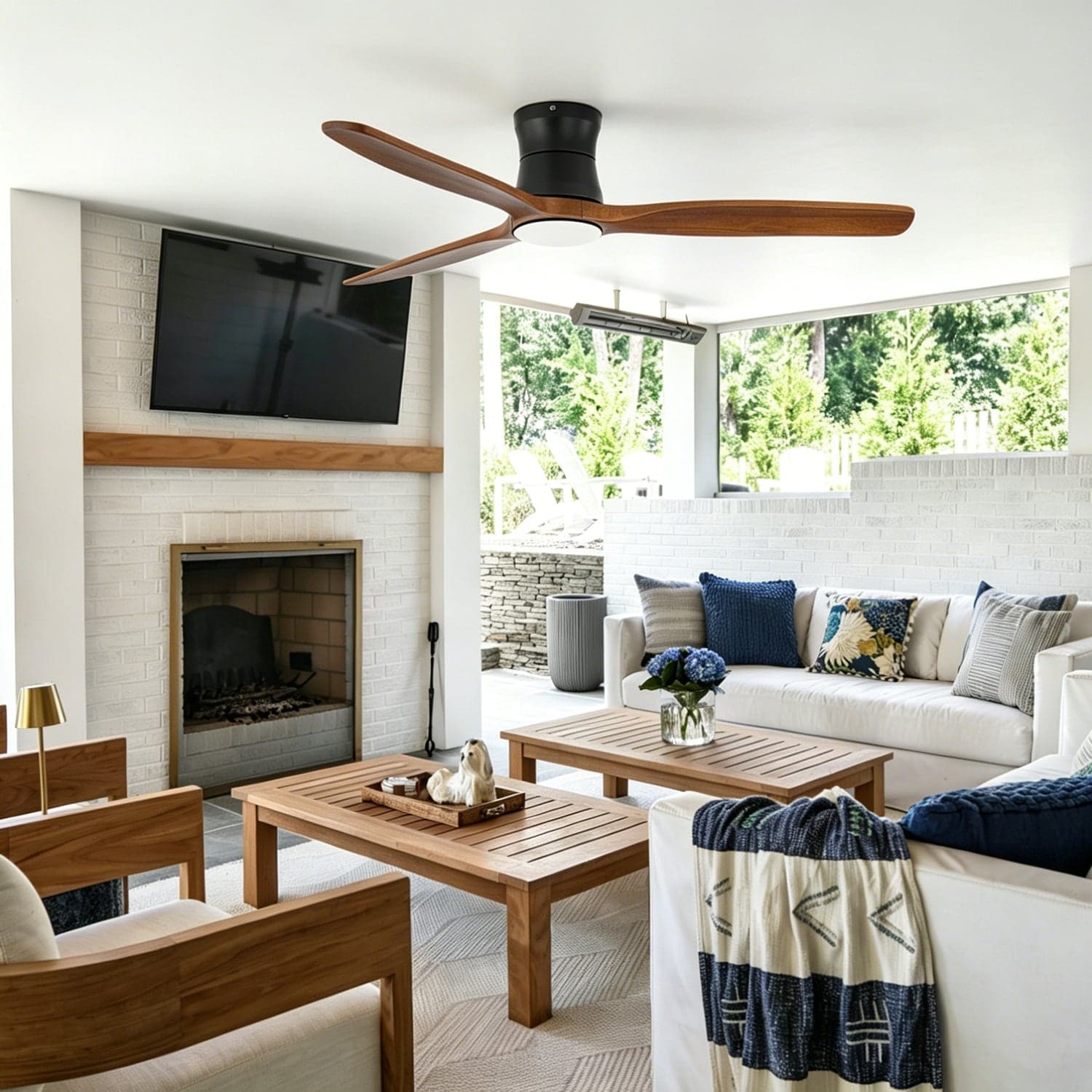
The Fjord 132
Solid wood · Ø 132 cm · Three Scandinavian blades
- ✓Oiled solid-wood blades, every unit is unique
- ✓Three-blade Scandinavian design: sculptural, never heavy
- ✓Ultra-silent DC motor, slow large-volume airflow
€339€429
Ventilation and air circulation: the key to perceived comfort
Shading reduces heat gain, ventilation evacuates residual heat. A well-ventilated conservatory breathes: high openings (heat rises) and low openings allow natural convection. Where architecture does not permit this, thermostatically controlled roof vents open automatically when temperature exceeds a threshold.
The ceiling fan is the most effective comfort tool in a conservatory. It does not cool the air but circulates it, creating a perceived wind-chill effect of 3-4°C, the difference between a dead 30°C and a liveable one. A fan like the Fjord 132, installed on the load-bearing structure, covers the entire surface with wide, silent circulation. It also runs in winter mode (reverse rotation) to redistribute warm air accumulated at height back to the occupied zone.
Suitable materials and furniture for a conservatory
A conservatory is subject to extreme thermal variations, from -5°C in winter to +45°C in summer in untreated cases. Not all materials withstand these extremes. Natural textiles fade and dry out in two seasons. Untreated wood warps. Cheap plastics yellow and become brittle.
Preferred materials: woven resin or synthetic rope for seating (UV-resistant, waterproof, low-maintenance); teak or oiled eucalyptus for wooden structures (stable under thermal variation); porcelain stoneware or natural stone for flooring (thermal inertia, frost resistance). For outdoor textiles, technical fabric brands (Sunbrella, Batyline) last 5-7 years in direct sun versus 1-2 years for standard upholstery.
A four-season conservatory is a balancing act: block excessive heat, welcome gentle warmth, circulate air continuously and choose materials that last. It is not the simplest room to design, it is potentially the most pleasant in the house. Our ceiling fans, designed for open and semi-open spaces, find their most natural use there: wide circulation, moisture resistance, and a walnut-and-brass design that withstands both time and aesthetics.
Frequently asked questions
Can you install a ceiling fan in an open or semi-open conservatory?+
Yes, provided you choose a model with an appropriate IP rating. For a partially open or humid conservatory, an IP44 (splash-proof) or IP54 fan is recommended. Also verify that the load-bearing structure can accommodate the fan's weight.
Which orientation is most difficult to treat thermally?+
West, because late-afternoon sun is the hottest of the day (surfaces have accumulated heat since morning) and the hardest to block, being low on the horizon. A west-facing conservatory without a variable-angle external blind quickly becomes uninhabitable in July and August.
Is double glazing enough to regulate a conservatory's temperature?+
No. Double glazing improves thermal insulation in winter but does not prevent overheating in summer, it actually retains heat that has already entered through solar radiation. The right solution for a year-round conservatory is double glazing + external blind + ventilation.
The SEY Maison Circle
Every month, an exceptional piece. Never reissued.
The Drops principle: one high-end furniture piece per month, in a numbered edition. Once it's gone, it never comes back. Circle members are notified 48 h early, access each drop 24 h before everyone else, and receive our guides before publication.
Discover the Drops →