Interior design
Living room lighting: the golden rules for perfect light at every hour
Published on ·3 min read
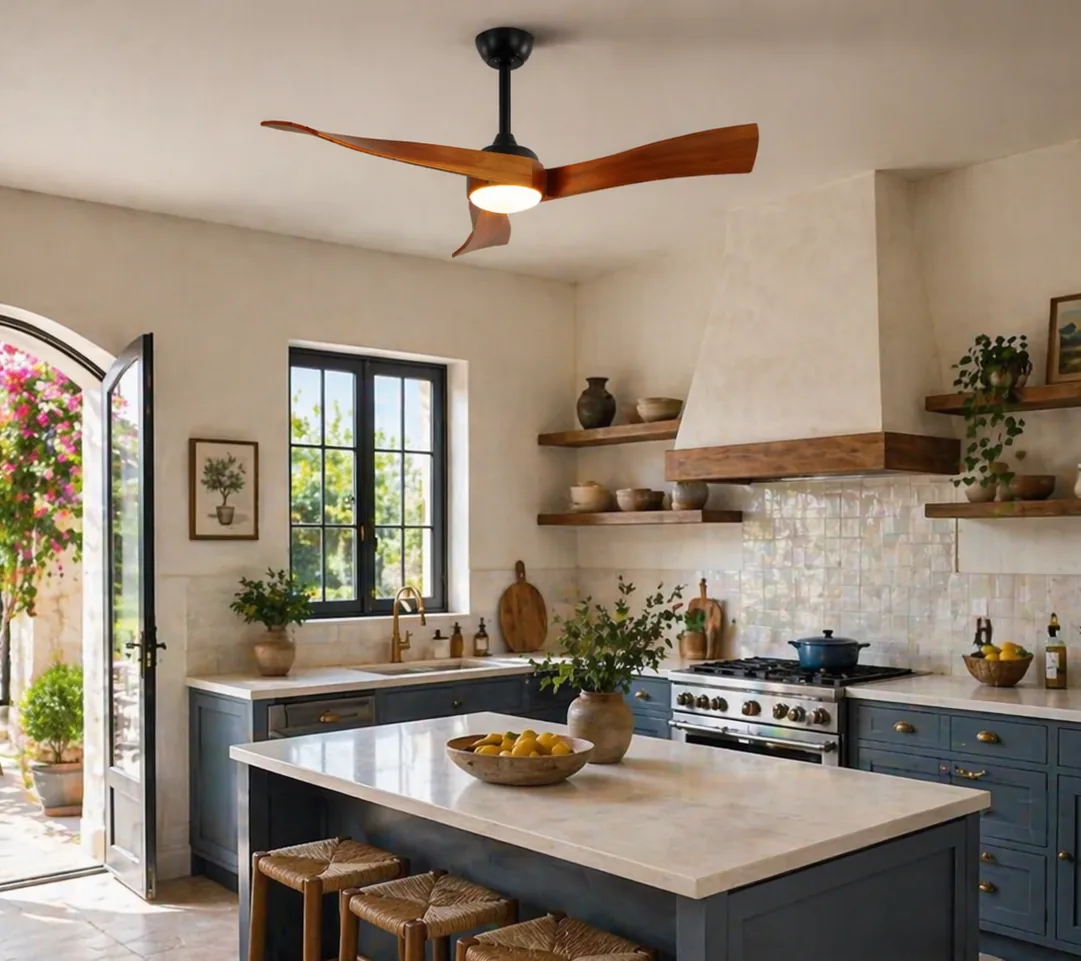
Lighting is probably the decorating decision with the greatest impact and the one most often rushed. A living room can be tastefully furnished with perfect colour choices, if the lighting is wrong, the space does not work. Too cold, it turns clinical. Too uniform, it flattens every texture. Too sparse, it creates a sad room even in daylight.
Interior designers think of lighting in layers, like a photographer or lighting director. This method, simple once understood, allows a living room to move smoothly from Sunday lunch to intimate dinner without ever ringing false.
The three layers: ambient, task, accent
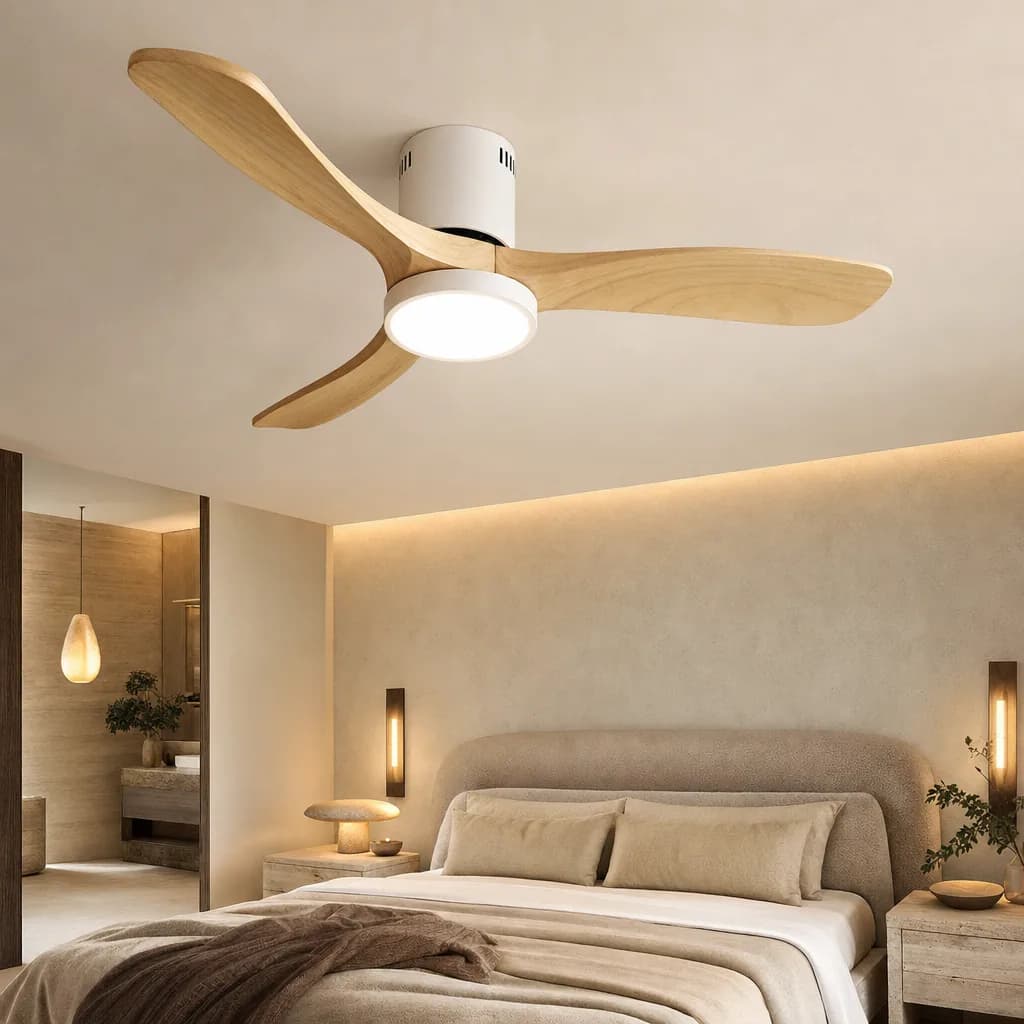
Ambient light is the room's general illumination, present everywhere without being harsh. Not a bare ceiling pendant: diffused light from a shaded chandelier, ceiling-bounced spotlights, or a fan-light fixture designed to diffuse without glare. Task lighting responds to uses: reading, desk work, cooking. Accent lighting highlights: a niche, a painting, a bookcase, it provides depth and character.
- ·Ambient: chandelier, diffusing ceiling fixture, indirect wall lights, the foundation
- ·Task: reading lamp, desk spot, low pendant above the dining table
- ·Accent: directional recessed spots, grazing light on a textured wall
Colour temperature: warm, neutral, cool, when to use which
Colour temperature is measured in Kelvins (K). Below 3,000 K, light is warm, amber, candle, wood tones. Between 3,000 and 4,000 K it is neutral-white, ideal for kitchens and offices. Above 5,000 K it turns blue-white: perfect for a bathroom, disastrous in a living room.
The rule for a premium residential living room: 2,700 K for relaxation zones (sofa, armchairs), 3,000 K maximum for reading areas. Mixing 2,700 K and 5,000 K sources in the same room is one of the most common mistakes, the eye cannot adapt and the space feels incoherent.
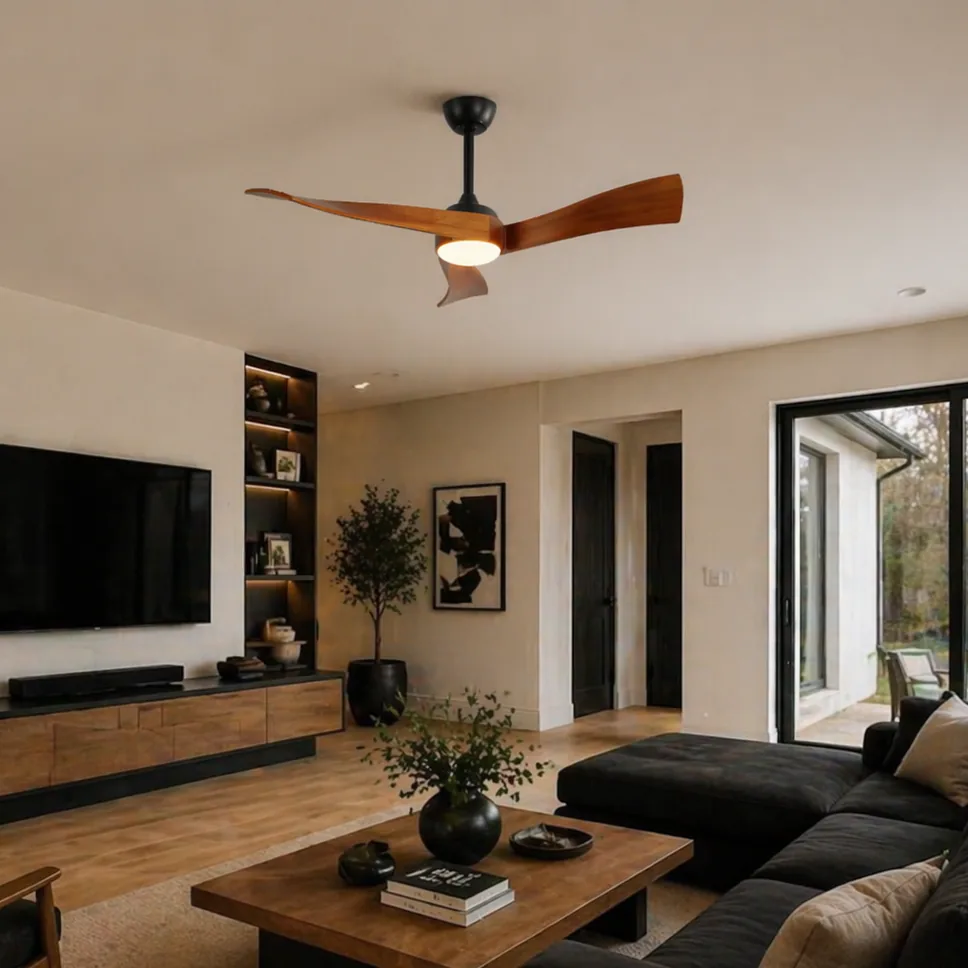
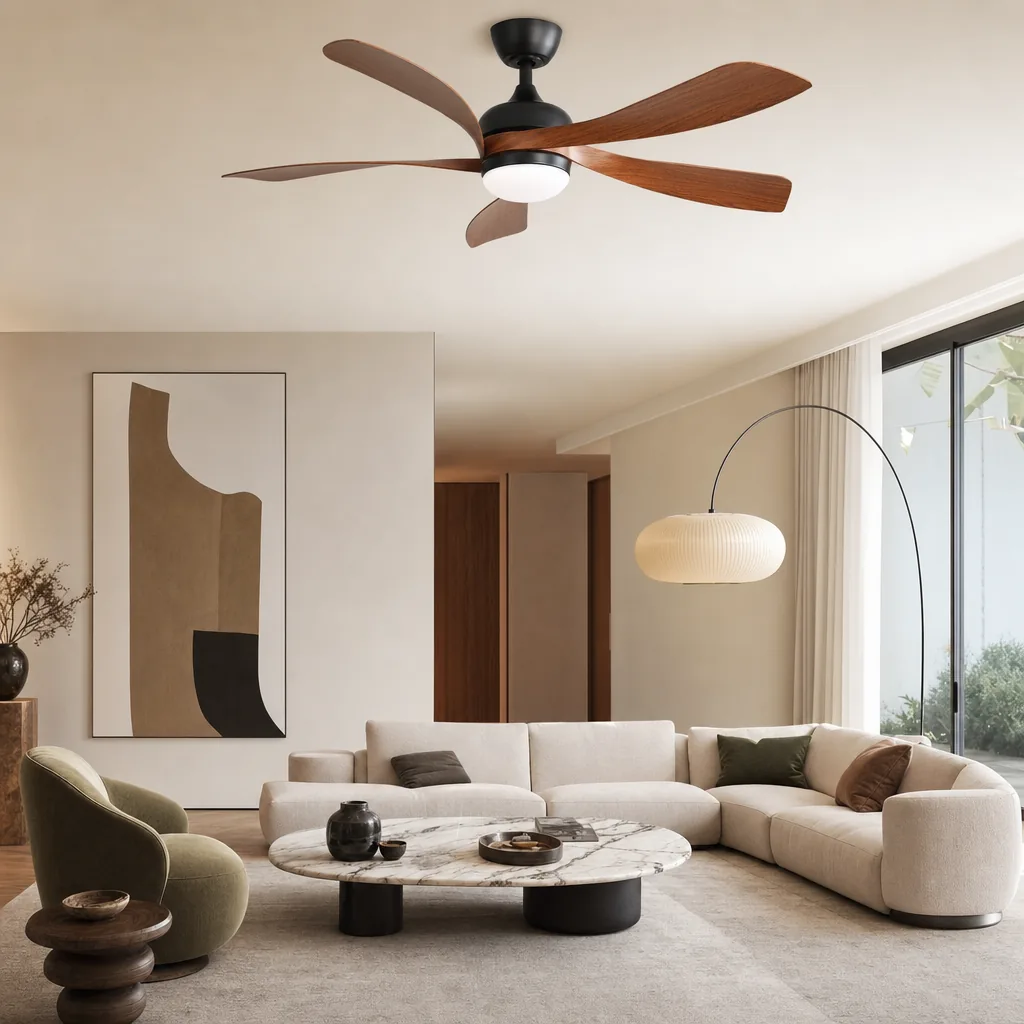
The Nord 132
Nordic black & walnut · Ø 132 cm · LED & remote
- ✓Silent DC motor, 6 reversible speeds
- ✓Remote control included
- ✓30-minute installation, illustrated manual
€339€429
Classic mistakes and how to avoid them
Mistake 1: a single central ceiling light. One overhead point source creates hard facial shadows and dark corners. It can anchor the ambient layer but never be the complete solution. Mistake 2: bare bulbs. An exposed filament in an open living space causes glare and eye fatigue within minutes.
Mistake 3: ignoring dimmers. A living room without dimming is a living room without atmosphere. Investing in LED-compatible dimmers, or a light fixture with a remote, radically changes a space's ability to adapt. The Nord 132 integrates a dimmable light kit so the fan alone handles two of the three lighting layers.
Planning your lighting: the circle method
On the room plan, draw circles around each use zone: sofa, coffee table, dining area, reading corner, bookcase. Each circle needs its own independent light source at the appropriate intensity. Then identify your main ambient source, task sources, and accent sources. If a circle has no dedicated source, it will remain in shadow, and the space will feel unfinished.
Successful lighting is lighting you do not notice, you notice the atmosphere, materials, and faces. Three layers, correct colour temperatures, and a few dimmers are enough to transform any living room. In this logic, choosing a fixture that also functions as a ceiling fan, like the Nord 132 with its walnut blades and dimmable kit, resolves two spatial questions with a single decision.
Frequently asked questions
How many light sources does a 25 m² living room need?+
Generally at least 4 to 6 distinct sources: one central ambient, two or three task or accent sources, and one or two low sources (table lamps). This number ensures modularity and eliminates dark zones.
Can you mix bulbs of different colour temperatures?+
In the same room, it is best to stay between 2,700 K and 3,000 K. Mixing in 4,000 K or above creates a visual dissonance the eye perceives as discomfort without being able to identify it precisely.
Do you need a dimmer on every source?+
Ideally yes, especially for ambient sources. In practice, a dimmer on the main source and one on the dining pendant covers 80% of needs. Table lamps can be replaced by models with built-in variable intensity.
The SEY Maison Circle
Every month, an exceptional piece. Never reissued.
The Drops principle: one high-end furniture piece per month, in a numbered edition. Once it's gone, it never comes back. Circle members are notified 48 h early, access each drop 24 h before everyone else, and receive our guides before publication.
Discover the Drops →